Showing posts with label Science. Show all posts

Thursday, August 28, 2008

Arctic Climate Tipping Point Happening Now! Sea Ice in Its “Death Spiral” Scientist Claims

from Treehugger and BBC:


After yesterday’s ominous news that North American permafrost (and presumably European and Asian, as well) stores 60% more greenhouse gases than we thought, here’s another siren announcing that we are rushing full speed ahead towards a climatic tipping point: 

Scientists are reporting that the extent of sea ice in the Arctic is at the second lowest point on record. Currently ice covers 2.03 million square miles; last year's sea ice coverage, 1.59 million square miles, set the record. In the past ten years Arctic sea ice has declined 10 percent.

Given the seriousness of the situation, I’ll let the scientists speak for themselves:

We Are Watching the Tipping Point Happen

Mark Serreze, a scientist from the National Snow and Ice Data Center in Boulder, Colorado was quoted by Reuters:

No matter where we stand at the end of the melt season it’s just reinforcing this notion that Arctic Ice is in its death spiral.


Serreze also told the AP that:

We could very well be in that quick slide downward in terms of passing a tipping point. It’s tipping now. We’re seeing it happen now.


Climate Change Happening More Quickly Than Models Have Predicted

The same article quoted NASA ice scientist Jaw Zwally as saying that within 5-10 years the Arctic could be ice-free in the summer. He added that this also means that:

Climate warming is also coming larger and faster than the models are predicting and nobody’s really taken into account that change yet.


As a commenter pointed out in my post on permafrost from yesterday, this is really the sort of news that should be on the front page of every newspaper, at the top of the broadcast of every nightly news service. I wholeheartedly agree with that sentiment. 

It's hard to not sound shrill with this: Climate change is happening more quickly than we thought in the Arctic and the frozen soils in the region contain a lot more stored carbon than the models used so far. Unless we get a handle on this now (yesterday would've been even better) global warming could very well overtake our efforts to slow it. That's not to say that we should throw in the towel (as no doubt some people will think) but rather is another sign that we have to redouble our efforts to reduce greenhouse gas emissions on a global level.

Tuesday, August 26, 2008

One of the reasons I like Biden as a VP

from Grist:
Joe Biden, Barack Obama's running mate, has earned an 83 percent lifetime score from the League of Conservation Voters during his 35 years representing Delaware in the U.S. Senate, voting fairly consistently with environmentalists and the mainstream of his party. In 2007, while running for president, he said "energy security" was his top priority, and argued that he was well-suited to deal with the challenge thanks to years of experience on the Senate Foreign Relations Committee, which he now chairs. Biden is also a big booster of biofuels. 

Key Points

Primary cosponsor of a "Sense of the Senate" resolution calling on the U.S. to participate in U.N. climate negotiations. He introduced it with Sen. Richard Lugar (R-Ind.) in the current Congress and the previous one.

Cosponsor of the Boxer-Sanders Global Warming Pollution Reduction Act, the most stringent climate bill in the Senate. It would establish a cap-and-trade system for greenhouse-gas emissions and require the U.S. to reduce its emissions to 1990 levels by 2020, and to 80 percent below 1990 levels by 2050. (Biden became a cosponsor of it more than three months after it was introduced and just days after both Hillary Clinton and Barack Obama signed on.)

In 2007, during his most recent run for president, called for raising fuel-economy standards for automobiles to an average of 40 miles per gallon by 2017 by increasing fuel-economy targets within vehicle classes by about one mile per gallon per year.

Called for increasing ethanol and biodiesel production by upping the national renewable-fuel standard to require that the fuel supply include 10 billion gallons of renewable fuel a year by 2010 and 60 billion gallons a year by 2030.

Called for 20 percent of the U.S. electricity supply to come from renewable sources.

Global warming time bomb trapped in Arctic soil: study

from TerraDaily:
Climate change could release unexpectedly huge stores of carbon dioxide from Arctic soils, which would in turn fuel a vicious circle of global warming, a new study warned Sunday.

And according to one commentary on the research, current models of climate change have not taken this extra source of greenhouse gas into account.

Scientists have long known that organic carbon trapped inside a blanket of frozen permafrost covering one fifth of the world's land mass would, if thawed, release greenhouse gases into the atmosphere.

But until now they simply did not have a good idea of how much carbon is actually locked inside this Arctic freezer.

To find out, a team of American researchers led by Chien-Lu Ping of the University of Alaska Fairbanks examined a wide range of landscapes across North America.

They took soil samples from 117 sites, each to a depth of at least one metre, in order to provide a full assessment of the region's so-called "carbon pool."

Previous estimates of the Arctic carbon pool relied heavily on a relative handful of measurements conducted outside of the Arctic, and only to a depth of 40 centimetres (15.5 inches).

The study, published in the British journal Nature Geoscience, found that the stock of organic carbon "is considerably higher than previously thought" -- 60 percent more than the previously estimated.

This is roughly equivalent of one sixth of the entire carbon content in the atmosphere.

And that is just for North America. The size and mix of landscapes in the northern reaches of Europe and Russia are about the same, and probably contain a comparable amount of carbon-dioxide producing matter currently held in check only by the cold, the study said.

And the danger of a thaw is real, note climate scientists.

The Nobel Prize-winning UN panel of climate change scientists project temperature increases by century's end of up to six degrees Celsius (10.8 degrees Fahrenheit) in the Arctic region, which is more sensitive to global warming than any other part of the planet.

Commenting on the research, Christian Beer of the Max Planck Institute in Jena, Germany, pointed out that the climate change models upon which future projections are based, do not include the potential impact of the gases trapped frozen Arctic soils.

"Releasing even a portion of this carbon into the atmosphere, in the form of methane or carbon dioxide, would have an significant impact on Earth's climate," he noted in his commentary, also published in Nature Geoscience.

Methane, another greenhouse gas, is less abundant than carbon dioxide but several times more potent as a driver of global warming.

Wednesday, June 25, 2008

Earth Near Tipping Point, Climatologist Warns

from the Toronto Star:

WASHINGTON-James Hansen returned to Capitol Hill a hero yesterday, but certainly not a conquering hero.

The soft-spoken scientist, hailed as the “whistle-blower for the planet,” tried to quiet a standing ovation from environmentalists here with a typically blunt admonition.

“It is not a time to celebrate,” said Hansen, 20 years to the day since he became the first leading scientist to warn of the dangers of global warming before a congressional committee.

He returned not to bask in any adulation, but to warn that the Earth is nearing a tipping point, to call for a national carbon tax and to say that CEOs of energy companies may be guilty of crimes against humanity and nature.

On June 23, 1988, by most accounts, the temperature in the committee room hovered at 38C and the U.S. was in the midst of a historic drought when Hansen told a Senate committee he was “99 per cent certain” that humans were warming the global climate.

His comments brought the issue to American consciousness.

The following day, The New York Times carried an account under the headline:

Global warming has begun, expert tells Senate.

Although global warming alarms had been sounding for more than a decade and Canadian scientists were warning of the greenhouse effect in the early 1980s, Hansen’s testimony seemed to crystallize the concern and provide the first jolt to the mass media in this country.

Two decades later, now 67 and director of NASA’s Goddard Institute for Space Studies, his message has not changed.

“We have reached a point of planetary emergency,” he said.

“There are tipping points in the climate system, which we are very close to, and if we pass them, the dynamics of the system take over and carry you to very large changes which are out of your control.”

During a speech at the National Press Club, he rambled, as if his ideas were sprinting well ahead of his words, but he kept an overflow ballroom audience rapt.

Already, he said, the world’s safe level of atmospheric carbon dioxide has been exceeded.

Yet, in the 20 years since he first testified, no major U.S. law restricting greenhouse gas emissions has been passed, 21 new coal-fired generating units have been built at power plants in this country and total U.S. emissions of carbon dioxide have climbed by about 18 per cent.

“If there is any single moment that marked the turning point where the climate issue became a serious public policy issue, June 23, 1988, had to be seen as that moment,” said Christopher Flavin, president of the Worldwatch Institute.

“(Yesterday) may mark a second kind of turning point.”

Tim Wirth, the onetime Democratic Colorado senator who organized the hearing that day, said he knew he had made much progress with Hansen’s testimony when a report made the swimsuit issue of Sports Illustrated.

“It was a brave and lonely leadership role he played then, and he hasn’t stopped one day since,” Wirth said.

Hansen’s second Capitol Hill appearance in 1989 was before a committee chaired by a Tennessee senator named Al Gore, but the White House edited his statement before Gore’s committee, throwing into question his certainty about the link between human activity and global warming.

Hansen was told he could accept the revisions, or he would not be able to testify.

So, in advance of the hearing, he asked Gore to question him on the edited parts, he then revealed the White House edit and the story led all U.S. network newscasts that evening. Hansen then moved out of the political spotlight for 15 years.

Yesterday, Hansen warned of greater forest fire risk in Canada, the extinction of polar and alpine species, danger to the coral reefs and the ocean life that depends on them because of carbon dioxide in the oceans, and refugees from melting ice sheets in Greenland and the western Antarctic.

He called for a phase-out of all coal-burning power plants by 2030 except those in which carbon dioxide is captured and buried and he called for a carbon tax on coal, oil and gas.

The tax, he said, should be returned in full to the public - not used by government - in equal amounts for each adult and a half-share for children, deposited directly into bank accounts or credited to debit cards.

Such a non-regressive tax, Hansen says, will spur low and middle-income people to limit their tax while profligate users will pay for their excesses.

He also accused corporate America of a “greenwash” in which their environmentally friendly words are not backed by actions and he supported criminal charges against CEOs of corporations such as ExxonMobil who are smart enough to know the situation but are intent on continuing their fossil fuel ways.

“When their descendants look back on them, they should not to be able to pretend that they didn’t know,” Hansen said.

“They do know.”

They are also guilty of funding and promoting contrarian views from scientists, furthering a charade that confuses the public into believing there is debate among scientists in this country, Hansen said.

“There is no debate,” he said.

Next year, with a new president, a new direction is desperately needed, Hansen said.

He said a call for offshore drilling, sounded last week both by U.S. President George W. Bush and Republican presumptive nominee John McCain is “crazy.”

“To go around drilling for the last drop of oil on the continental shelf will extend our addiction a little bit, but it will put us past the tipping point,” he said.

Tuesday, May 27, 2008

w00t!!!!!!!!!!!!!!!!!!

from Nasa.gov:


NASA's Mars Phoenix Lander can be seen parachuting down to Mars, in this image captured by the High Resolution Imaging Science Experiment (HiRISE) camera on NASA's Mars Reconnaissance Orbiter. This is the first time that a spacecraft has imaged the final descent of another spacecraft onto a planetary body.

From a distance of about 310 kilometers (193 miles) above the surface of the Red Planet, Mars Reconnaissance Orbiter pointed its HiRISE obliquely toward Phoenix shortly after it opened its parachute while descending through the Martian atmosphere. The image reveals an apparent 10-meter-wide (30-foot-wide) parachute fully inflated. The bright pixels below the parachute show a dangling Phoenix. The image faintly detects the chords attaching the backshell and parachute. The surroundings look dark, but corresponds to the fully illuminated Martian surface, which is much darker than the parachute and backshell.

Phoenix released its parachute at an altitude of about 12.6 kilometers (7.8 miles) and a velocity of 1.7 times the speed of sound.

The HiRISE, acquired this image on May 25, 2008, at 4:36 p.m. Pacific Time (7:36 p.m. Eastern Time). It is a highly oblique view of the Martian surface, 26 degrees above the horizon, or 64 degrees from the normal straight-down imaging of Mars Reconnaissance Orbiter. The image has a scale of 0.76 meters per pixel.

This image has been brightened to show the patterned surface of Mars in the background.


HFS!!!!!  what a picture..... Now if John Carter would just ride by,,,,,,,,

Monday, January 22, 2007

AHHH,,,,,,,,,,


There she goes... : The McNaught comet is seen early morning from Pucon, Calafquen Lake sector, Chile. (AFP/David Lillo)

Friday, January 19, 2007

Cheap, safe drug kills most cancers

 from New Scientist:

It sounds almost too good to be true: a cheap and simple drug that kills almost all cancers by switching off their “immortality”. The drug, dichloroacetate (DCA), has already been used for years to treat rare metabolic disorders and so is known to be relatively safe.

It also has no patent, meaning it could be manufactured for a fraction of the cost of newly developed drugs.

Evangelos Michelakis of the University of Alberta in Edmonton, Canada, and his colleagues tested DCA on human cells cultured outside the body and found that it killed lung, breast and brain cancer cells, but not healthy cells. Tumours in rats deliberately infected with human cancer also shrank drastically when they were fed DCA-laced water for several weeks. (more)


Comet McNaught

from Spaceweather.com:

Comet McNaught is the brightest comet to appear in centuries. 
Only visible in the Southern Hemisphere, this photo gallery compiled by Spaceweather.co gives us in the North a hint of the beauty.

One more reason I should have immigrated to New Zealand in 2002.
 

Wednesday, January 17, 2007

Climate change moves 'Doomsday Clock' closer to midnight

from BBC:

Experts assessing the dangers posed to civilisation have added climate change to the prospect of nuclear annihilation as the greatest threats to humankind.

As a result, the group has moved the minute hand on its famous "Doomsday Clock" two minutes closer to midnight.

The concept timepiece, devised by the Bulletin of the Atomic Scientists, now stands at five minutes to the hour.

The clock was first featured by the magazine 60 years ago, shortly after the US dropped its A-bombs on Japan.

Not since the darkest days of the Cold War has the Bulletin, which covers global security issues, felt the need to place the minute hand so close to midnight. (more)


Friday, April 21, 2006

NASA Black Hole Simulation


There's a great bit of animation with article. Real Sensawonda Stuff.


NASA scientists have reached a breakthrough in computer modeling that allows them to simulate what gravitational waves from merging black holes look like. The three-dimensional simulations, the largest astrophysical calculations ever performed on a NASA supercomputer, provide the foundation to explore the universe in an entirely new way.

According to Einstein's math, when two massive black holes merge, all of space jiggles like a bowl of Jell-O as gravitational waves race out from the collision at light speed.


Previous simulations had been plagued by computer crashes. The necessary equations, based on Einstein's theory of general relativity, were far too complex. But scientists at NASA's Goddard Space Flight Center in Greenbelt, Md., have found a method to translate Einstein's math in a way that computers can understand. (more)

A Real 'Green' House: No Heating Bill for 25 Years

from ScienceDaily:


When David Mears and his wife Dorothy put their house up for sale at the end of last year, it wasn't just the four-plus acres of beautiful woodlot land that made the property appealing. Nor were the five bedrooms or extra cabinet space in their roomy kitchen the most significant features.

The main attraction was the fact that the couple hadn't paid their heating bill for more than 25 years.

That's because they hadn't received one since 1980.

Using his knowledge of alternative energy sources for commercial greenhouses in response to the energy crisis of the 1970's, David Mears, a professor of Bioresource Engineering at Rutgers University, virtually eliminated the use of fuel oil for heating his home. (more)

The beauty of this system is that it uses 25 year old technology and works quite well. So much for the myth that says you can't depend on solar power for heating in the NorthEast.

Wednesday, April 19, 2006

Find Leaves IDiots Snakebitten

A true transitional fossil. The second in as many weeks! HOO HAH!

from Pharyngula:


Najash rionegrina, a snake with legs


It's a busy time for transitional fossil news—first they find a fishapod, and now we've got a Cretaceous snake with legs and a pelvis. One's in the process of gaining legs, the other is in the early stages of losing them.

Najash rionegrina was discovered in a terrestrial fossil deposit in Argentina, which is important in the ongoing debate about whether snakes evolved from marine or terrestrial ancestors. The specimen isn't entirely complete (but enough material is present to unambiguously identify it as a snake), consisting of a partial skull and a section of trunk. It has a sacrum! It has a pelvic girdle! It has hindlimbs, with femora, fibulae, and tibiae! It's a definitive snake with legs, and it's the oldest snake yet found.

(more)

Meat-Eaters Aiding Global Warming?

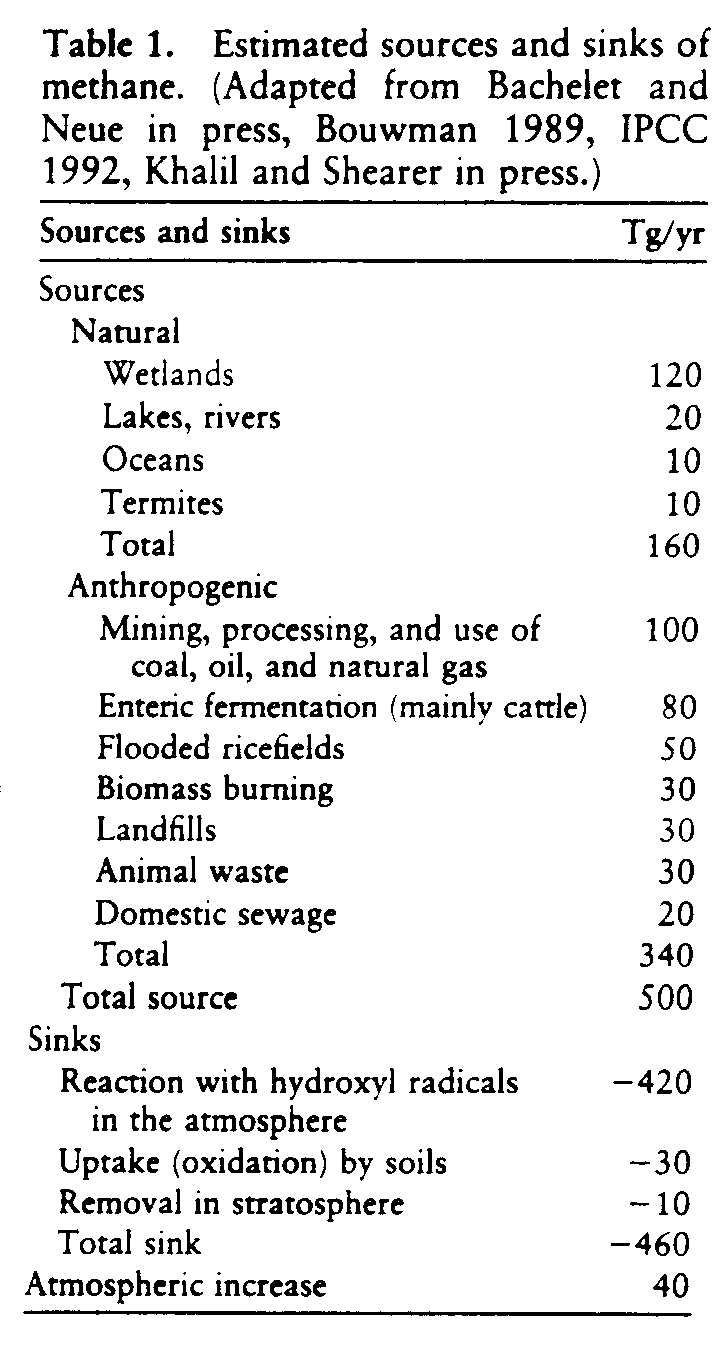
Take a close look at the chart to the left. Note that the items enteric fermintation and animal wastes account for 110 Tg/yr of methane production . That's nearly as much as all non-anthropogenic sources produce and more than the amount from gas, oil, and coal use.

Now comes the study below which factors in the costs in greenhouse gasses in the production of various diets.

The results are pretty grim.

So I think it's time to put my mouth where my money is, I guess. Years ago I foreswore drivng as a contribution to a better environment. In as much as I fulminate regularly about the coming global climate change on this blog and elsewhere, it now looks like I must give up meat as well.

It's for the best from a health standpoint anyway. So here goes. My goal is to be meat free by my birthday in July. And please consider joining me.

I'll write from time to time on my struggle to become less of a carnivore.


from ABC News:

Your personal impact on global warming may be influenced as much by what you eat as by what you drive.

That surprising conclusion comes from a couple of scientists who have taken an unusual look at the production of greenhouse gases from an angle that not many folks have even thought about. Gidon Eshel and Pamela Martin, assistant professors of geophysics at the University of Chicago, have found that our consumption of red meat may be as bad for the planet as it is for our bodies.

If you want to help lower greenhouse gas emissions, they conclude in a report to be published in the journal Earth Interactions, become a vegetarian.

In the interest of full disclosure, it should be noted that both researchers are vegetarians, although they admit to cheating a little with an occasional sardine. They say their conclusions are backed up by hard data.

Eshel and Martin collected that data from a wide range of sources, and they examined the amount of fossil-fuel energy — and thus the level of production of greenhouse gases — required for five different diets. The vegetarian diet turned out to be the most energy efficient, followed by poultry, and what they call the 'mean American diet,' which consists of a little bit of everything.

There was a surprising tie for last place. In terms of energy required for harvesting and processing, fish and red meat ended up in a 'virtual tie,' but that's just in terms of energy consumed. When you toss in all those other factors, such as bovine flatulence and gas released by manure, red meat comes in dead last. Fish remains in fourth place, some distance behind poultry and the mean American diet, chiefly because the type of fish preferred by Americans requires a lot of energy to catch.

Eating Red Meat Like Driving an SUV?


Can changing your diet really have much of an impact?


'It is comparable to the difference between driving an SUV and driving a reasonable sedan,' said Eshel, who drives a Honda Civic, and only when he has to.

Eshel, who grew up on a farm, has always been interested in ecology and the impact we have on the planet. He got into this research, he says, because 'now that I'm a professor of geophysics, I have tools in my tool kit that I can apply much more quantitatively and rigorously to evaluate what we do."

Tuesday, April 18, 2006

Another Blow to the Case for IDiocy

from ScienceDaily:

Evolution Of 'Irreducible Complexity' Explained

Using new techniques for resurrecting ancient genes, scientists have for the first time reconstructed the Darwinian evolution of an apparently "irreducibly complex" molecular system.

The research was led by Joe Thornton, assistant professor of biology at the University of Oregon's Center for Ecology and Evolutionary Biology, and will be published in the April 7 issue of SCIENCE.

How natural selection can drive the evolution of complex molecular systems -- those in which the function of each part depends on its interactions with the other parts--has been an unsolved issue in evolutionary biology. Advocates of Intelligent Design argue that such systems are "irreducibly complex" and thus incompatible with gradual evolution by natural selection.

"Our work demonstrates a fundamental error in the current challenges to Darwinism," said Thornton. "New techniques allowed us to see how ancient genes and their functions evolved hundreds of millions of years ago. We found that complexity evolved piecemeal through a process of Molecular Exploitation -- old genes, constrained by selection for entirely different functions, have been recruited by evolution to participate in new interactions and new functions." more


Friday, February 17, 2006

Glacier Melt Could Signal Faster Rise in Ocean Levels

from the WaPo:

By Shankar Vedantam
Washington Post Staff Writer
Friday, February 17, 2006; Page A01

Greenland's glaciers are melting into the sea twice as fast as previously believed, the result of a warming trend that renders obsolete predictions of how quickly Earth's oceans will rise over the next century, scientists said yesterday.

The new data come from satellite imagery and give fresh urgency to worries about the role of human activity in global warming. The Greenland data are mirrored by findings from Bolivia to the Himalayas, scientists said, noting that rising sea levels threaten widespread flooding and severe storm damage in low-lying areas worldwide.


This undated photo provided by the journal Science shows East Greenland icebergs. Large numbers of bergs are calved each year from the fast-flowing terminus of Kangerdlussuaq Glacier, East Greenland. Iceberg production is a major form of mass loss from ice sheets.


(AP Photo/ho/J.A. Dowdeswell, Science) (J.a.dowdeswell - AP)


The scientists said they do not yet understand the precise mechanism causing glaciers to flow and melt more rapidly, but they said the changes in Greenland were unambiguous -- and accelerating: In 1996, the amount of water produced by melting ice in Greenland was about 90 times the amount consumed by Los Angeles in a year. Last year, the melted ice amounted to 225 times the volume of water that city uses annually.

"We are witnessing enormous changes, and it will take some time before we understand how it happened, although it is clearly a result of warming around the glaciers," said Eric Rignot, a scientist at the California Institute of Technology's Jet Propulsion Laboratory.(more)

Friday, February 10, 2006

Climate 'warmest for millennium'

from BBC:

In the late 20th Century, the northern hemisphere experienced its most widespread warmth for 1,200 years, according to the journal Science.

The findings support evidence pointing to unprecedented recent warming of the climate linked to greenhouse emissions.

University of East Anglia researchers measured changes in fossil shells, tree rings, ice cores and other past temperature records or "proxies".

They also looked at people's diaries from the last 750 years.

Timothy Osborn and Keith Briffa of UEA analysed instrument measurements of temperature from 1856 onwards to establish the geographic extent of recent warming.

Then they compared this data with evidence dating back as far as AD 800.

The analysis confirmed periods of significant warmth in the Northern Hemisphere from AD 890 - 1170 (the so-called "Medieval Warm Period") and for much colder periods from 1580 - 1850 (the "Little Ice Age").

Natural records

The UEA team showed that the present warm period is the most widespread temperature anomaly of any kind since the ninth century.

"The last 100 years is more striking than either [the Medieval Warm Period or Little Ice Age]. It is a period of widespread warmth affecting nearly all the records that we analysed from the same time," co-author Timothy Osborn told the BBC.

Osborn and Briffa used 14 sets of temperature records from different locations across the Northern Hemisphere.

The records included long life evergreen trees growing in Scandinavia, Siberia and the Rockies which had been cored to reveal the patterns of wide and narrow tree rings over time. Wider rings related to warmer temperatures.

The chemical composition of ice from cores drilled in the Greenland ice sheets revealed which years were warmer than others.


Dear diary

The researchers used proxy data developed from the diaries of people living in the Netherlands and Belgium during the past 750 years that revealed, for example, the years when the canals froze.

"These records extend over many centuries and even thousands of years. We simply counted how many of those records indicated that, in any one year, temperatures were warmer than average for the region they came from," said Dr Osborn.

Professor John Waterhouse, director of the Environmental Sciences Research Centre Anglia Ruskin University in Cambridge commented: "Although we're getting increasingly accurate measurements of present-day temperature, we've got nothing like that from the past to compare those with.

"There's much uncertainty in past reconstructions. You've got to look at the reconstructed data in the past in light of the likely errors that those data have."

But he added: "As we get more and more evidence in, it is looking as if the current period is the warmest for over 1,000 years."

In November, Science published a paper showing atmospheric levels of the greenhouse gases carbon dioxide and methane are higher now than at any time in the past 650,000 years.

Thursday, October 06, 2005

Richard Dawkins on the Opiate of the Masses

from Prospect via Cruella-Blog:


Gerin oil (or Geriniol to give it its scientific name) is a powerful drug which acts directly on the central nervous system to produce a range of characteristic symptoms, often of an antisocial or self- damaging nature. If administered chronically in childhood, Gerin oil can permanently modify the brain to produce adult disorders, including dangerous delusions which have proved very hard to treat. The four doomed flights of 11th September were, in a very real sense, Gerin oil trips: all 19 of the hijackers were high on the drug at the time. Historically, Geriniol intoxication was responsible for atrocities such as the Salem witch hunts and the massacres of native South Americans by conquistadores. Gerin oil fuelled most of the wars of the European middle ages and, in more recent times, the carnage that attended the partitioning of the Indian subcontinent and, on a smaller scale, Ireland.


Gerin oil addiction can drive previously sane individuals to run away from a normally fulfilled human life and retreat to closed communities from which all but confirmed addicts are excluded. These communities are nearly always limited to one sex, and they vigorously, often obsessively, forbid sexual activity. Indeed, a tendency towards agonised sexual prohibition emerges as a drably recurring theme amid all the colourful variations of Gerin oil symptomatology. Gerin oil does not seem to reduce the libido per se, but it frequently leads to a prurient desire to interfere with, and preferably reduce, the sexual pleasure of others. A current example is the horror with which Gerin oil users view homosexuality, even when expressed in long-term loving relationships.

Gerin oil in strong doses can be hallucinogenic. Hardcore mainliners may hear voices in their heads, or see illusions which seem to the sufferers so real that they often succeed in persuading others of their reality. An individual who reports high-grade hallucinogenic experiences may be venerated, and even followed as some kind of leader, by others who regard themselves as less fortunate. Such following-pathology can long postdate the leader's death, and may expand into bizarre psychedelia such as the cannibalistic fantasy of "drinking the blood and eating the flesh" of the leader.

Strong doses of Geriniol can also lead to "bad trips," in which the user can suffer morbid delusions and fears, notably fears of being tortured, not in the real world but in a postmortem fantasy world. Bad trips of this kind are bound up with a punishment culture which is as characteristic of this drug as the obsessive fear of sexuality already noted. The punishment culture fostered by Gerin oil culminates in the sinister drug-induced fantasy of "allo-punishment"—the belief that individuals can and should be punished for the wrongdoings of others (known on the in-group grapevine as "redemption").

Medium doses of Gerin oil, though not in themselves dangerous, can distort perceptions of reality. Beliefs that have no basis in fact are immunised, by the drug's own direct effects on the nervous system, against evidence from the real world. Oil-heads can be heard talking to thin air or muttering to themselves, apparently in the belief that private wishes so expressed will come true, even at the cost of mild violation of the laws of physics. This autolocutory disorder is often accompanied by weird tics, hand gestures or other stereotypies, for example rhythmic head-nodding towards a wall.

As with many drugs, refined Gerin oil in low doses is largely harmless, and can even serve as a social lubricant on occasions such as marriages, funerals and ceremonies of state. Experts differ over whether such social use, though harmless in itself, is a risk factor for upgrading to harder and more addictive forms of the drug.

Gerin oil acts synergistically with sleep deprivation, self-mutilation and starvation. Addicts have been known to fast, whip their own backs, or perform other painful "penances" as means of enhancing the drug's potency. Mutilation is not limited to users themselves. Various Gerin oil-based sub-cultures ritually injure their own children, especially when they are too young to resist. These mutilations usually involve the genitals.

You might think that such a potentially dangerous and addictive drug would top the list of proscribed substances, with exemplary sentences handed out for trafficking in it. But no, it is readily obtainable anywhere in the world and you don't even need a prescription. Professional pushers are numerous, and organised in hierarchical cartels, openly trading on street corners and even in purpose-made buildings. Some of these cartels are adept at parting clients from their money. Their "godfathers" occupy influential positions in high places, and they have the ear of presidents and prime ministers. Governments don't just turn a blind eye to the trade, they grant it tax-exempt status. Worse, they subsidise schools with the specific intention of getting children hooked.

I was prompted to write this article by the smiling face of a very happy man in Bali (see picture). He was ecstatically greeting the news that he was to be executed by firing squad for the brutal murder of large numbers of innocent holidaymakers whom he had never met. Some people in the court were shocked at his lack of remorse. But far from remorseful, his mood was one of obvious exhilaration. He punched the air, delirious with joy that he was to be "martyred," to use the jargon of his particular sub-culture of Gerin oil substance-abusers. For, make no mistake about it, this beatific smile, looking forward with unalloyed pleasure to the firing squad, is the smile of a junkie. Here we have the archetypal mainliner, doped up with hard, unrefined, unadulterated, high-octane Gerin oil.

It is easy to regard such people as evil criminals, from whom the rest of us need protection. Indeed, we do need protecting from them. But the problem would not arise in the first place if children were protected from becoming hooked on a drug with such a bad prognosis for their adult minds

Wednesday, October 05, 2005

Observations indicate Arctic thaw


from CNEWS:


(AP) - New satellite observations show sea ice in the Arctic is melting faster, while air temperatures in the region are rising sharply, scientists said.

Since 2002, satellite data have revealed unusually early springtime melting in areas north of Siberia and Alaska. Now the melting trend has spread throughout the Arctic, said a U.S. collaboration of scientists.

The latest observations through September show melting in 2005 began a record 17 days earlier than usual.

The observations showed 5.3 million square kilometres of sea ice as late as Sept. 19. That's the lowest measurement of Arctic sea ice cover ever recorded, the researchers said. It's also 20 per cent less than the average of end-of-summer ice pack cover measurements recorded since 1978.

At the same time, average air temperatures across most of the Arctic region from January to August 2005 were as much as three degrees C warmer than average temperature over the last 50 years, said the team of researchers from two universities and NASA.

"The melting and retreat trends are accelerating," Ted Scambos, of the University of Colorado at Boulder's National Snow and Ice Data Center, said in a statement released by the university.

The results have not yet been published in a scientific journal.

"The one common thread," Scambos said, "is that Arctic temperatures over the ice, ocean and surrounding land have increased in recent decades."

The scientists stopped short of directly blaming the melting trend on global warming but said they have few other explanations at this point.

During the 1990s, a cyclical atmospheric circulation pattern called the Arctic Oscillation was believed to have been pushing sea ice out of the region and into adjacent waters. But the oscillation has weakened in recent years and yet the melting continued and even accelerated.

"Something has fundamentally changed here and the best answer is warming," said Mark Serreze, another researcher at the snow and ice data centre.

Sea ice records in the Arctic are sketchy before 1978. Since satellite observations began in earnest, researchers said Arctic ice has been retreating at a rate of more than eight per cent a decade.

And, they suspect, the melting may only contribute to even higher arctic temperatures in the future. That's because the bright white ice tends to reflect more of the sun's radiation. With more of the dark ocean exposed, the seawater tends to absorb more heat and reduce the amount of solar energy reflected back into space.

The researchers used satellite data from NASA, the National Oceanic and Atmospheric Administration and the U.S. Defence Department, as well as data from Canadian satellites and weather observatories.

The Colorado institute led the study that also involved two NASA laboratories, the National Oceanic and Atmospheric Administration and the University of Washington.

Did warm waters fuel Hurricane Katrina?

from PhysicsWeb:

5 October 2005

Global warming could have been responsible for the devastating effects of hurricane Katrina according to researchers in the US. Menas Kafatos and colleagues at George Mason University say that higher sea surface temperatures, caused by an increased concentration of greenhouse gases, caused Katrina to grow from a category 1 hurricane to a maximum category 5 hurricane. Although other factors could be responsible, the results suggest that hurricanes like Katrina will become more common in the future (physics/0509177).

Figure A

Spatial distribution of sea surface temperatures in August 2005 in the Gulf of Mexico (image:physics/0509177).


In papers written before Hurricane Katrina various researchers - including Kerry Emanuel of the Massachusetts Institute of Technology (Nature 436 686) and Peter Webster of Georgia Tech and co-workers (Science 309 1844) - reported that hurricanes have steadily become stronger over the last 25 years, and particularly in the last few years. This could be due to higher sea surface temperatures providing "fuel" for the hurricanes. Generally, the sea surface temperature must be above about 26°C for hurricanes to form and intensify.

Figure B

Sea surface temperature anomaly for August from 1982 to 2005 peaking in August 2005 with an increasing positive trend -- the trend is indicated by dashed line (image: physics/0509177).


Using satellite data from the Tropical Rainfall Measuring Mission Instrument, Kafatos and co-workers analysed how sea surface temperatures in the Gulf of Mexico have varied over the last 30 years. They found that mean sea surface temperatures were over 30°C throughout August this year, with a patch of 33°C next to the state of Louisiana (figure A). Furthermore, sea surface temperatures in the Gulf reached a record 0.8°C above normal compared to previous years (figure B). Hurricane Katrina caused devastation in New Orleans and the surrounding area when it reached the Louisiana coast on 29 August.

Figure C

Daily variations of surface latent heat flux and sensible heat flux values for August 2005 -- their average values for the period 2000-2005 are indicated by dashed lines (image: physics/0509177).


In addition to sea temperatures, hurricane behaviour is dictated by two other phenomena: surface latent heat flux, which is related to water evaporating and condensing; and sensible heat flux, which leads to changes in the temperature of the atmosphere. Inside a hurricane, latent heat can be converted into kinetic energy to produce secondary circulation which, in turn, can intensify the hurricane. Kafatos and co-workers found that daily variations of surface latent heat and sensible heat fluxes increased significantly during the intensification period of hurricane Katrina, so further adding to its strength (figure C).

"The Gulf waters should be continuously monitored using satellites to discern whether the increase continues in the following years," says Kafatos. "If this turns out to be the case, it will mean similar catastrophic events in the future."

However, further evidence is needed before climate scientists can be sure that there is a direct connection between global warming and the recent increases in hurricane intensity. For instance, the increase in the temperature of the sea needs to extend deep below the surface, whereas most satellites can only measure the temperature of a thin layer of water at the surface.

About the author

Belle Dumé is science writer at PhysicsWeb