Patrick McGoohan (1928-2009)
Stuff and Nonsense: Paranoia, Poetry, Politics, Popular Culture, Science and Assorted Weirdness
Showing posts with label Science Fiction. Show all posts
Wednesday, January 14, 2009
Monday, September 22, 2008
Joan Winston, ‘Trek’ Superfan, Dies at 77
from NYT:
By WILLIAM GRIMES
Published: September 20, 2008
For the “Star Trek” faithful, it was a historic event. Gene Roddenberry, the creator of the series, showed up. So did the science fiction writer Isaac Asimov, not to mention fans dressed as Klingons, Tribbles and Bele from the planet Ceron. NASA delivered a scaled-down lunar module and a spacesuit.
It was January 1972, and the first Star Trek convention was under way in a rented ballroom at the Statler Hilton in Manhattan. The organizers had expected a crowd of about 500. In the end, more than 3,000 fans turned up, so many that by the final day of the event registrars were issuing ID cards made from torn scraps of wrapping paper. For fans of the series, the convention marked the moment when a diaspora became a nation.
And it made a subculture celebrity of Joan Winston, who played a leading role in creating the event and went on to achieve a second-order fame as one of world’s most avid “Star Trek” fans. She died of Alzheimer’s disease on Sept. 11 at age 77, her cousin Steven Rosenfeld said. She lived in Manhattan.
Like many SF fans from the period, I "knew" Joan mostly by sight and reputation. She truly was a force of nature.
Labels:
Obituaries,
Popular Culture,
Science Fiction,
TV
Thursday, July 31, 2008
Nobel Prize Winner Doris Lessing on Science Fiction
from New York Times Magazine:
For the last two decades, most of your fiction has veered toward science fiction, which has disappointed literary critics like Harold Bloom.
I can’t be bothered with Bloom. A lot of people think some of my best writing is in science fiction, and they are just as significant as bloody Bloom.
Labels:
Art,
Make My Day,
Popular Culture,
Science Fiction
Tuesday, April 29, 2008
Bebe Barron (1925-2008)
Scored the Science Fiction Film "Forbidden Planet"

Bebe Barron, a pioneering composer who started manipulating sounds after receiving a tape recorder as a wedding present and later scored the 1956 science-fiction film “Forbidden Planet," the first full-length feature to use only electronic music, has died. She was 82.

Bebe Barron, a pioneering composer who started manipulating sounds after receiving a tape recorder as a wedding present and later scored the 1956 science-fiction film “Forbidden Planet," the first full-length feature to use only electronic music, has died. She was 82.
Barron died April 20 of complications related to old age at Cedars-Sinai Medical Center in Los Angeles, said her son, Adam Barron.
With her engineer husband, Louis Barron, she created “a soundscape for 'Forbidden Planet' that no one could ever have imagined," Jon Burlingame, a film music historian who teaches at USC, told The Times. “It was hugely ground-breaking." (more)
Labels:
Movies,
Music,
Obituaries,
Popular Culture,
Science Fiction
Village people

From Kolchak:
The forthcoming remake of The Day the Earth Stood Still promises to be a Richter-scale disaster. The new version of The Andromeda Strain, coming soon to A&E, is only slightly less offensive. And don't get me started on how Will Farrell is turning Land Of the Lost into a comedy....
Despite this tidal wave of mediocrity, though, there may be reason for optimism.
Yes, really.

ITV, the British television network, has announced that it will be producing a six-episode version of The Prisoner,, the genre-bending series from the late 1960s starring Patrick McGoohan. So far, the only name associated with the new show is the writer, Bill Gallagher. However, there is a persistent rumor that Christopher Eccleston (Doctor Who) may star.

Meanwhile, director Christopher Nolan (Batman Begins and Momento) is supposedly working on a feature-length version of The Prisoner, with a script from Janet and David Peoples ( Blade Runner and 12 Monkeys ).
I think this new burst of interest in The Prisoner carries some interesting implications with it, beyond Hollywood’s fascination with remakes. To explain this properly though is going to require some background.

In this series, McGoohan plays a British secret agent who resigns from his job without warning. or explanation. (Although it is never mentioned specifically in any episode, most fans of the show believe that McGoohan was still playing John Drake, the character he introduced in an earlier show, Secret Agent.) However, before he can leave London, this former agent is abducted and taken to the Village, a prison for individuals--seemingly from around the world, not just England--who have too much classified information in their heads to be allowed their freedom.

The Village appears to an aggressively quaint seaside community, but the Victorian architecture hides high-tech surveillance devices and brutal mind-control experiments. Attempted escapes are often dealt with the by the Rovers, huge white spheroids that look like they escaped from a really big lava lamp.

Day-to-day operations in the Village are controlled by an individual known as Number 2. Usually, there was a different performer in this role every week, but one or two were called back for an encore. The new arrival is designated Number 6, and is told that he is being held because the Powers That Be--the people Number 2 is reporting to--want to know why he resigned. Number 6's response has become the show's mantra::
" I am not going to be pushed, filed, indexed, stamped, briefed, debriefed or numbered. My life is my own."

The remainder of the series-- there was a total of 17 episodes--becomes a battle of wills as the Village tries to break Number 6, and he tries to escape.

The Prisoner starts as a peculiar twist on the spy shows popular in the 1960s but eventually turns into a surrealistic parable about identity, integrity and the possible misuses of technology. As the show evolves, McGoohan starts to write and direct segments, as well as star in them. (He is also credited as co-creator.) In order to tell his story, he borrows symbols and techniques from a wide variety of genres and styles, which both fascinated and alienated his audience Some viewers probably had both reactions at the same time.
While the original "Prisoner" isn't shown regularly on TV, it's never really gone away, either. It's usually available on home video--whatever this week's hot new format is--and it clearly influenced other creators. References to the series can be found in Babylon 5; the original run of the Fantastic Four comic book; the current version of Battlestar Galactica and The Simpsons.
That's right, The Simpsons
The Prisoner was a groundbreaking series in a lot of ways, but here are two that I don't think are mentioned as often as they should be:

As for me, I was in high school when The Prisoner debuted in America. I was fairly familiar with Secret Agent , but this show caught me completely by surprise. It quickly took up permanent residence in my imagination. For a long time, I didn't see any real need for a remake, even though some of the elements of the original hadn't aged very well.
Now, though, I'm not so sure.
Here at the Daily Blatt, handrummer ran a photo of what can only be called a propaganda poster promoting the increased use of video surveillance in England. The poster promises that the public will be "secure beneath the watchful eyes" of the television cameras.

When this sort of sentiment becomes a real poster in the real world, I think you can draw only one of two conclusions: either The Prisoner has been totally eclipsed by reality or it's time to do a remake Really really time. This may be one of those rare occasions where Hollywood's perpetual quest for pre-sold properties actually matches up with a contemporary issue.
Hey, it could happen. It may already be happening, with movies like V For Vendetta or comics like Marvel's Civil War, which takes a metaphorical look at fighting terrorism and excesses of government power.
However, if either of the "Prisoner" remakes are going to be as intense as the original, a number of difficult creative decisions are going to have to be made., over and above things like casting a new Number Six.

For example, in the original series, McGoohan went to Portmeirion, a resort community in Wales, to shoot the exterior shots of the Village. The fanboy side of me says that it won't really be The Prisoner unless they go back to Portmeirion. On the other hand, technology has changed so much over the years, that it may no longer be necessary to give a prison a geographic location. In this world of GPS and electronic house arrest, it may be the Prisoner carries his jail cell around with him in some way.
Finding an appropriate resolution to the story is going to be tricky too, particularly since McGoohan's own conclusion left a lot of people frustrated and annoyed.
According to the various books about the show, McGoohan wanted to produce six, maybe eight, episodes. However, when he pitched the idea to Lew Grade, the president of ITV, Grade wanted enough for a standard syndication package (which, according to which source you use, was anything from 24 to 32 episodes.) ITV did finance the show, but there was constant tug-of-war about how many episodes there were going to be.

"Once Upon a Time," the next-to-last episode in the original series, deals with Number Six giving Number Two (Leo McKern, one of the actors who played the role more than once), a nervous breakdown during a bizarre psychodrama called Degree Absolute. The episode ends with another member of the Village staff asking Number Six what he wants.
The Prisoner replies he wants to see Number One, and he leaves with the staffer. This was apparently McGoohan's original idea of how the series should end.

However, he eventually added one more episode, "Fall Out." He may have been under pressure to provide a tidy, straightforward conclusion to the show. If he was, though, he managed to withstand it. "Fall Out" is filled with surrealistic images, overlapping dialogue and strange musical combinations. Calling it psychedelic is an understatement.. McGoohan (who also wrote and directed the episode) does provide some answers, but I think it takes multiple viewings to find them.
handrummer and I, along with several of our friends, once saw "Fall Out" dubbed into French, while attending a world science fiction convention in Toronto. It actually turned out to be a good experience. Since neither drummer nor I could speak French, we weren't even tempted to try and follow the dialogue. It allowed us concentrate on the images.
As I've said though, the episode didn't sit well with audiences at the time, and I'm not sure how well that approach would go over with most modern audiences. On the other hand, it's going to be difficult to come up with a realistic ending that hasn't already been seen on the news. In the late 1960s, the possibility that the Good Guys were running the Village was shocking. Now, though, we've seen smaller versions of the Village in the real world: the CIA's "safe houses" for suspected terrorists. Maybe one of the remakes will be called The Prisoner: Extraordinary Rendition.
In general, I imagine both production companies are going to be tempted to make changes just to keep the two versions distinct from each other, never mind whether it enhances the story. It's going to be a tricky balancing act, but I'm looking forward to seeing how it's all going to....um, fall out.
Labels:
Kolchak,
Movies,
Popular Culture,
Science Fiction
Wednesday, April 16, 2008
Gotta Stop Slammin' My Head in the Door.....

STAR TREK™ Casket
The STAR TREK Casket styling has been inspired by the popular “Photon Torpedo” design seen in STAR TREK II: The Wrath of Khan. Caskets will be available beginning late 2008.
Labels:
Ohmyghod,
Popular Culture,
Science Fiction,
There are no words,
Weirdness,
WTF
Wednesday, April 09, 2008
Admiral Adama's New Clothes
From Kolchak:


All of this may just boil down to one idea: BSG takes itself too seriously. I remember reading one of the BSG producers saying that the show was more serious and realistic than any of the Star Trek shows. (I think the speaker was David Eick, but I can't swear to it now.) I still remember the line because, within a few days of reading it, I saw an episode of BSG that featured a catfight between the new Starbuck and one of the organic Cylon women. I have no real problems with staging catfights,. but I do have a problem when someone tries to label them serious science fiction.

There's one in every crowd...and, this time, it looks like I'm going to be the one.
Battlestar Galactica is back on the SciFi Channel, with the first half of its fourth and last season. The show is regularly praised as the best dramatic series on television, regardless of genre. Even the writers at io9.com, who have apparently never met a snarky remark they didn't like, didn't include BSG in its recent poll of overrated sf shows.
All of this is pretty impressive, but I've never been able to join this particular choir. The charm of the new BSG has, in general, eluded me. For a while, I was intrigued by how the creative staff had turned a show that could charitably be called an oddity into something serious. But then I started noticing things...
My biggest problem with the new BSG is the new visualization of the Cylons. As I understand it, there are now Cylons who are indistinguishable from human beings. The original Cylons have been producing these organic models for 20, maybe 40, years, since the end of the first war with humanity. To be able to do that would require some major upgrades in technology, I think.
The real question here, though, is not how the Cylons do it, but why do they do it.It apparently has something to do with the Cylons finding God. Or a god. (Why would the Cylons acknowledge anything as a god, anyway?) But that's all I can tell you. Maybe that's all any viewer can tell you. And I certainly can't tell you why the Cylon god or the new organic Cylons ordered a new invasion of the Twelve Colonies.
Another thing about the organic Cylons is that they come in sets. Each of them have several duplicates. Why? Don't ask me. Nothing I've seen suggests any sort of link between members of a set/litter/clutch/whatever. No telepathy, no shared knowledge, no group mind.
By the way, a lot of statements in the piece are going to be qualified with words like "apparently" and "As I understand it." I've not seen every episode, and, at this point, I don't plan to. I've seen the first dozen or so episodes in the weekly series; the occupation of New Caprica and about a half-dozen miscellaneous episodes. I think that's a fair sampling, but there are probably going to be people who think otherwise.
The other problems I have with the new BSG are harder to explain. They deal more with feelings and impressions, rather than story logic. But I think they're worth talking about.
Battlestar Galactica is a dark, depressing show. It presents a universe where mankind is totally at the mercy of forces beyond its control, where the best you can hope for is to stay alive and keep running. Some people say this is a needed antidote to the Star Trek universe and maybe it is. However, it doesn't make a show that I want to watch every week.
The protagonists of Firefly andFarscape are the bottom of the social ladders in their respective universes, but they still win, from time to time. Even when the characters are behaving outrageously (Chiana sleeping with both D'Argo and his son in Farscape) they're still interesting, and understandable. I've never gotten that from "Galactica."The show has been praised for its political commentary, but I have mixed feelings about it. I did like the occupation of New Caprica arc, but I thought the episode where abortion was outlawed on the Colonial Fleet was nonsensical, particularly since the decision to prohibit abortions was based on a study of population trends in the fleet that was pulled out of the air for this episode. At least one reviewer has said that choices like this proves BSG's willingness to question the sacred cows of both the right and the left.
To me, though, it just seems inconsistent, and sloppy.

All of this may just boil down to one idea: BSG takes itself too seriously. I remember reading one of the BSG producers saying that the show was more serious and realistic than any of the Star Trek shows. (I think the speaker was David Eick, but I can't swear to it now.) I still remember the line because, within a few days of reading it, I saw an episode of BSG that featured a catfight between the new Starbuck and one of the organic Cylon women. I have no real problems with staging catfights,. but I do have a problem when someone tries to label them serious science fiction.
Thursday, April 12, 2007
Friday, January 19, 2007
Happy Birthday!

Edgar Allan Poe
(1809 –1849)
Poet, short story writer, editor, critic
Leader of the American Romantic Movement.
(1809 –1849)
Poet, short story writer, editor, critic
Leader of the American Romantic Movement.
Best known for his tales of the macabre, Poe was one of the early American practitioners of the short story and a progenitor of detective fiction and crime fiction. He is also credited with contributing to the emergent science fiction genre.
Labels:
Happy Birthday,
Popular Culture,
Science Fiction
Saturday, January 13, 2007
Robert Anton Wilson
from the San Jose Mercury News:
Robert Anton Wilson, author of 'Illuminatus' trilogy, dies at 74
CAPITOLA, Calif. - Robert Anton Wilson, co-author of the cult classic "The Illuminatus! Trilogy," a science-fiction series about a secret global society, has died. He was 74.
Wilson died peacefully of natural causes at his home Thursday in Capitola in Santa Cruz County, his daughter Christina Pearson said Saturday.
Post-polio syndrome had severely weakened Wilson's legs, leading to a fall seven months ago that left him bedridden until his death, Pearson said.
Wilson wrote 35 books on subjects such as extrasensory perception, mental telepathy, metaphysics, paranormal experiences, conspiracy theory, sex, drugs and what he called quantum psychology.
Wikipedia
Robert Anton Wilson, author of 'Illuminatus' trilogy, dies at 74
CAPITOLA, Calif. - Robert Anton Wilson, co-author of the cult classic "The Illuminatus! Trilogy," a science-fiction series about a secret global society, has died. He was 74.
Wilson died peacefully of natural causes at his home Thursday in Capitola in Santa Cruz County, his daughter Christina Pearson said Saturday.
Post-polio syndrome had severely weakened Wilson's legs, leading to a fall seven months ago that left him bedridden until his death, Pearson said.
Wilson wrote 35 books on subjects such as extrasensory perception, mental telepathy, metaphysics, paranormal experiences, conspiracy theory, sex, drugs and what he called quantum psychology.
Wikipedia
Labels:
Living in the World,
Obituaries,
Science Fiction,
Weirdness
Saturday, November 11, 2006
The Most Significant SF Books of the Last 50 Years
I am not all that surprised by how many of these I've read, just as I'm not surprised by the ones I have not. Sword of Shanana is one of the worst books ever typed. Thomas Covenant is a leper of the soul as well as the body and as such was totally unreadible for me.
(ones in red not read)
The Most Significant SF & Fantasy Books of the Last 50 Years, 1953-2002
from SFBC
- Lord of the Rings, JRR Tolkien
- Foundation Trilogy, Isaac Asimov
- Dune, Frank Herbert
- Stranger in a Strange Land, Robert A,. Heinlein
- A Wizard of Earthsea, Ursula K. Le Guin
- Neuromancer, William Gibson
- Childhood's End, Arthur C. Clarke
- Do Androids Dream of Electric Sheep?, Philip K. Dick
- The Mists of Avalon, Marion Zimmer Bradley
- Fahrenheit 451 Ray Bradbury
- The Book of the New Sun, Gene Wolfe
- A Canticle for Leibowitz, Walter M. Miller, Jr.
- The Caves of Steel, Isaac Asimov
- Children of the Atom, Wilmar Shiras
- Cities in Flight, James Blish
- The Colour of Magic, Terry Pratchett
- Dangerous Visions, edited by Harlan Ellison
- Deathbird Stories, Harlan Ellison
- The Demolished Man, Alfred Bester
- Dhalgren, Samuel R. Delany
- Dragonflight, Anne McCaffrey
- Ender's Game, Orson Scott Card
- 1st Chronicles of Thomas Covenant. Stephen Donaldson
- The Forever War, Joe Haldeman
- Gateway, Frederik Pohl
- Harry Potter & the Philosopher's Stone, JK Rowling
- Hitchhiker's Guide to the Galaxy, Douglas Adams
- I Am Legend, Richard Matheson
- Interview with the Vampire, Anne Rice
- The Left Hand of Darkness, Ursula K. Le Guin
- Little, Big, John Crowley
- Lord of Light, Roger Zelazny
- The Man in the High Castle, Philip K. Dick
- Mission of Gravity, Hal Clement
- More Than Human, Theodore Sturgeon
- The Rediscovery of Man, Cordwainer Smith
- On the Beach, Nevil Shute
- Rendezvous with Rama, Arthur C. Clarke
- Ringword, Larry Niven
- Rogue Moon, Algis Budrys
- The Silmarillion, J.R.R. Tolkien
- Slaughterhouse-5, Kurt Vonnegut
- Snow Crash, Neal Stephenson
- Stand on Zanzibar, John Brunner
- The Stars My Destination, Alfred Bester
- Starship Troopers, Robert A. Heinlein
- Stormbringer, Michael Moorcock
- The Sword of Shannara, Terry Brooks
- Timescape, Gregory Benford
- To Your Scattered Bodies Go, Philip Jose Farmer
Jack Williamson
The second book I have any real memory of reading was Mr. Williamson's The Humanoids. I had just read the first, Isaac Asimov's David Starr, Space Ranger, and the one/two punch of these books made me, at age 9, a lifelong passionate reader of science fiction . I had the privilege of meeting Mr. Williamson several times. At the 1989 World Science Fiction Convention in Boston I had a long conversation with him and was able to express my enormous gratitude for what his writing had meant to me. He was a man of great high plains charm, soft spoken, gentle and above all surpassingly intelligent. Go find his books. They are too.
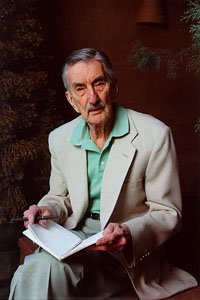
Update: Betty Williamson said her uncle would often say "I have lived a wonderful life, and I will die with no regrets."
Update: Obits:
Update: Betty Williamson said her uncle would often say "I have lived a wonderful life, and I will die with no regrets."
Update: Obits:
The LA Times
Clovis News Journal
from Locus:
SF Grand Master Jack Williamson, born 1908, died this afternoon at his home in Portales, New Mexico, at the age of 98. His first published story was "The Metal Man" in Amazing Stories in 1928, the beginning of a writing career that spanned nine decades. His work ranged from early space opera series The Legion of Space (beginning 1934), werewolf SF/fantasy Darker Than You Think (1940), thoughtful SF classic The Humanoids (1948), Golden Age antimatter tale Seetee Ship (1951 as by Will Stewart), and time travel series Legion of Time (1952). Later works included Hugo and Nebula Award winning novella "The Ultimate Earth" (2000) and its novel expansion Terraforming Earth (2001), winner of the John W. Campbell Memorial Award. He won a Hugo Award in 1985 for autobiography Wonder's Child, and his career honors include a Pilgrim Award for his nonfiction work including H.G. Wells: Critic of Progress (1973), SFWA's 2nd Grand Master Award in 1976, Life Achievement World Fantasy and Bram Stoker awards, induction in the SF Hall of Fame in 1996, and Grandmaster of the World Horror Convention in 2004. The Jack Williamson Science Fiction Library was established in 1982 at Eastern New Mexico University, which for 30 years has hosted an annual Lectureship in honor of the writer. Williamson's last novel was The Stonehenge Gate (2005).
Monday, November 06, 2006
Nelson Bond

I met Mr Bond many years ago at a convention in Roanoke. Somehow, I ended up with the great good fortune of talking to him for 5 or 6 hours that day. He gave me an veritable seminar on the old pulp days. A true gentleman, he was a fascinating tale teller. He was also for many years one of the foremost booksellers in fandom.

from Locus:
Nelson Slade Bond was born November 23, 1908, in Scranton PA, and grew up in Philadelphia. He attended Marshall University, Huntington WV, from 1932 to 1934, and that was also where he met his wife, Betty Gough Folsom; they married in 1934, and had two sons. He worked as a public relations field director for the Province of Nova Scotia in 1934-'35, then began freelance writing, at first with non-fiction pieces.
The first of his many story sales came in 1935, but he came to science fiction and fantasy in 1937 with SF ''Down the Dimensions'' (Amazing) and the memorable humorous fantasy ''Mr. Mergenthwirker's Lobblies'' (Scribner's). The latter, which spawned several related stories, was turned into a radio series, and eventually a TV play. He wrote extensively for Amazing Stories, Fantastic Adventures, Weird Tales, and non-genre magazines Scribner's and Blue Book. His ''Magic City'' in Astounding (1941), part of the ''Meg the Priestess'' series, was very popular. His works were collected in Mr. Mergenthwirker's Lobblies and Other Fantastic Tales (1946), The Thirty-first of February (1949), The Remarkable Exploits of Lancelot Biggs, Spaceman (1950), No Time Like the Future (1954), and Nightmares and Daydreams (1968)
from the Roanoke Times
Nelson Bond's career included fantastical fiction, radio and TV, and local theater.
He wrote about bumbling space travelers, invisible companions, a great bird that would hatch from the Earth as from an egg, a secret race of superhumans who could walk through walls.
He wrote radio scripts and television plays when the mediums were still young, and was once named in a lawsuit filed by Orson Welles -- though he quickly got himself dropped from the suit.
Though he retired from fiction writing in the 1950s, books collecting his stories continued to appear, the most recent, "Other Worlds Than Ours," published just last year.
Longtime Roanoke resident Nelson Bond died Saturday of complications from heart problems, less than a month shy of his 98th birthday. Bond, once called the dean of Roanoke writers, leaves behind more than 250 short stories and a career that earned him the admiration of authors as diverse as Isaac Asimov and Sharyn McCrumb.
"Nelson Bond was large on the horizon for anyone who enjoyed fantastic literature as far back as the '30s," said Harlan Ellison, the 2006 Grand Master Award recipient from the Science Fiction and Fantasy Writers of America.
"For originality and inventiveness he was rara avis," an extraordinary person, Ellison said. "He wrote a clean line of prose, because he understood in that best part of a writer's craft where the soul resides that when you have a fantastic idea in the story line, you must have internal logic."
Ellison, who built his own writing career on short stories, looked to Bond for inspiration, as did Ray Bradbury, who in a 2001 interview with The Roanoke Times praised Bond's sense of humor and quirky imagination.
Born in 1908, Bond grew up in Philadelphia, where his father ran a public relations firm. He attended West Virginia's Marshall College, now Marshall University, where he met Betty Folsom, marrying her in 1934. By 1939, when the couple moved to Roanoke, Bond had already established himself as a prolific and popular writer. Often, he dictated his stories and his wife typed them.
Throughout the 1930s, '40s and '50s he wrote sports, detective and fantasy stories that appeared in magazines ranging from Esquire to Weird Tales. As radio and then television caught on, he was there, scripting hundreds of shows for the national networks.
When he entertained guests in the basement of his Roanoke County home, Bond often shared war stories of his time in television.
He scripted the 1957 CBS teleplay "The Night America Trembled," dramatizing the national reaction to the Orson Welles radio broadcast of "The War of the Worlds." It was that show that resulted in Welles' lawsuit.
Bond's signature story was the tongue-twistingly titled "Mr. Mergenthwirker's Lobblies," the story of a man with two invisible companions who can foretell the future. He wrote several sequels and adapted them to radio. When "Mergenthwirker's" aired on NBC in 1946, it was the first full-length play broadcast by a television network.
The teleplay's director, Fred Coe, who went on to be a powerful television producer, invited Bond to join him in the new medium of television, but Bond declined. He later spoke of Coe's offer as a great opportunity that he had missed.
By the 1950s, frustrated with the oppressive working conditions for writers in Hollywood and the death of the pulp magazines, Bond retired from writing. He first opened a public relations firm in Roanoke, then became a bookseller. He was also instrumental in founding the Showtimers community theater, where his nationally renowned stage adaptation of George Orwell's "Animal Farm" was first performed.
Betty Bond had her own career in local television, interviewing notable locals for "The Betty Bond Show" on WSLS (Channel 10).
But Nelson Bond's writing career wasn't quite over. Ellison recalled badgering Bond in the early 1970s to write his first new story in more than a decade, "Pipeline to Paradise," which was eventually published in 1995.
"I'm the one who shook Nelson out of retirement," Ellison said. The new story proved that even though Bond had not written fiction in years, "he still had the chops."
In the 1970s Bond's fans gathered locally to form the Nelson Bond Society, which became the seed for many of the Roanoke-based science fiction conventions and clubs.
In 1998, the Science Fiction and Fantasy Writers of America honored him with an Author Emeritus award. In 2003, Bond donated his papers to the Marshall University library, which created a replica of the office in Bond's home where he wrote most of his stories.
Fred Eichelman, who runs the Point North science fiction convention, called Bond a "Renaissance person." His organization's latest newsletter has a photo of Bond and "The Empire Strikes Back" screenwriter Leigh Brackett arm in arm on the cover.
Eichelman, a retired schoolteacher who used Bond's stories in the classroom, recalled an instance when a student wrote to Bond asking what motivated him to write.
"My motivation was to put three meals on the table for my family," Bond replied.
Even with his most creative years behind him, Bond said in 2001 that he had never grown bored. "You've just got to stay interested in life, that's all."
He is survived by his wife, Betty, sons Kit and Lynn, and many grandchildren and great-grandchildren.
Monday, September 25, 2006
Charles L Grant
A man of great wit, wielder of an impossibly huge literary talent and the possessor of a stunningly giving heart.
Someone who could make you laugh as the ghouls were sawing off your head and whose horror stories could frighten the bejeesus out of the staunchest secular humanist.
Fan of his beloved football Giants.
Fellow devotee of chop-sockee movies.
And a great Scot as well.
That was a bit of what Charlie brought to the world.
I had the privilege to call him my friend.
Ghod how I will miss him.
.

from Locus Online:
Writer and editor Charles L. Grant, born 1942, died yesterday, Sept. 15, 2006, shortly after returning home from a long hospital stay. Grant wrote over 100 books, mostly horror and fantasy, under his own name and a variety of pseudonyms, notably the "Oxrun Station" novels set in an imaginary Connecticut town. He won Nebula Awards for short story "A Crowd of Shadows" and novelette "A Glow of Candles, a Unicorn's Eye", World Fantasy Awards for anthology Shadows (first in an 11-volume series), collection Nightmare Seasons, and novella "Confess the Seasons", a special British Fantasy Award in 1987, a Life Achievement Stoker Award in 2000, the World Horror Grandmaster Award in 2002, and the International Horror Guild Living Legend Award in 2003.
From International Horror Guild:
Charles L. Grant has been writing for thirty some years now, and in that time he's published over 100 books in various genres, with a number of his novels appearing on the bestseller lists of USA Today, New York Times, Los Angeles Times, and London Times. His nearly two hundred short stories have been published in anthologies and magazines worldwide. He also edited the award-winning anthology series, Shadows. Other anthologies included Gothic Ghosts (with Wendy Webb), the Gallery of Fear, and the Greystone Bay series.
In 1987 he received the British Fantasy Society's Special Award, for life achievement. In addition, he has received two Nebula Awards and three World Fantasy Awards for his writing and editing. In 2000 he was given the Horror Writers Association's Lifetime Achievement Award. In 2002 he was honored with the Grandmaster Award of the World Horror Convention.
A graduate of Trinity College in Hartford, Grant served two years in Vietnam. He is a past officer of the Science Fiction Writers of America, served ten years on the Board of Directors of the World Fantasy Awards, and is a past president and trustee of the Horror Writers Association. He shares his Victorian home in northwestern New Jersey with his writer/editor wife, Kathryn Ptacek, five cats, and a lot of cobwebs and a few earwigs. Currently he is at work on a dark fantasy novel.
Thursday, August 31, 2006
What I did on my summer vacation
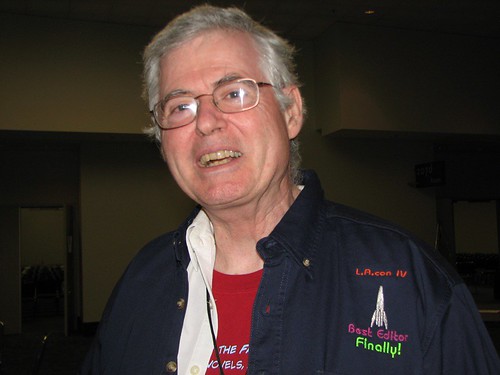
David Hartwell wins Best Editor Hugo
Best Editor: Finally!
My convention boss Scott Dennis, on behalf of the Clothiers Guild, presented David Hartwell, with this shirt, commemorating his Hugo win for Best Editor.
Best Editor: Finally!
My convention boss Scott Dennis, on behalf of the Clothiers Guild, presented David Hartwell, with this shirt, commemorating his Hugo win for Best Editor.
Subscribe to:
Comments (Atom)