Showing posts with label Kolchak. Show all posts

Friday, January 09, 2009

Keep on trucking

(Or, Kolchak gets into shape by jumping to conclusions.)


I’m not a truck driver—and I’m sure that comes as a big surprise to everyone—but I drive the interstates often enough to have noticed a few changes in truck stops.

One change I’ve noticed is that there aren’t as many truck stops as there used to be. Now, you’re more likely to find a travel center or a travel stop than a truck stop. I’m not sure what the new nomenclature accomplishes, if anything. Maybe the owners are just trying to make their places more attractive to non-truckers.

Another change seems to be taking place on the paperback rack. You can find a lot of westerns and war stories at truck stops—sorry, travel centers—but I don’t think that’s new. What may be new is the number of science fiction and fantasy novels you can find. There seems to be a focus on series books, rather than individual novels : Star Trek novels in sf and series like Forbidden Realms and Warhammer in fantasy.

Over at the audiobook rack, things are changing too. On my most recent trips, I’ve been looking at a series of CDs that are described as full-cast dramatizations and “Movies for your mind.” This series features adaptations of prose stories featuring DC super heroes and post-holocaust action stories.

I’ve seen four different series in the latter category: Death Lands; Outlanders; The Survivalist and Doomsday Warrior. I know the first two are active series, but I’m pretty sure The Survivalist is out-of-print and I think Doomsday Warrior is too.

In an ultimate sense, you could call the emphasis on pulp-style characters depressing, but, personally, I have a very simple rule-of-thumb here: reading for pleasure is better than not reading for pleasure. And the same thing holds with listening for pleasure.

Tuesday, December 16, 2008

Now THIS is holiday cheer....

One of the best covers I have ever heard....

Check out their other stuff..  Phenominal group...

Tip of the old sombrero to Kolchak for turning me on to these guys. I was having a truly horrible day...and it just went away....

Tuesday, October 21, 2008

The Pettigrew principle

From KOLCHAK:


Barack Obama’s campaign for the presidency is nothing less than a history-marking event, regardless of how it turns out. For those of us who attended Catholic school in the 1960s, however, the campaign is not entirely unfamiliar.

If you were attending Catholic school at that time, you could subscribe to a comic book called Treasure Chest. As you might imagine, given the time and the audience, there were lots of “educational “and “inspirational” stories in Treasure Chest. As an adult, I would probably find these stories stupid or offensive, or both…if I remembered them. Fortunately, the stories I remember are the ones that slipped in under the radar. There was a series about kids living on a space station that I remember liking, and there was 1976: Pettigrew For President..

From what I’ve been able to put together so far, 1976: Pettigrew For President ran for 10 chapters in 1964. Treasure Chest came out every two weeks, so the story played out over roughly half a school year. The title character was Gov. Timothy Pettigrew, who was running for his party’s presidential nomination in that exotic future year of 1976. I would’ve been in fifth grade when the series ran, but my parents were already wondering how much longer would I be reading those weird funnybooks.

It probably took me a couple of chapters before I realized that there was something strange about “Pettigrew.” We would never see the governor’s face. We would hear his voice as part of a telephone conversation, but, if he was in the room, his head would always be blocked by something, or someone. I knew that the strip’s creators were building up to something, but I don’t think I had any theories about what it was. So I was definitely surprised when, on the last page of the story, as he accepts his party’s nomination, Tim Pettigrew is revealed to be African-American.

I know: to an adult, this all sounds heavy-handed, at best. To a fifth-grader, though, it was anything but, even though we never find out if the governor was elected president.
For what it’s worth, there’s a similar reveal in “Judgment Day,” a story that appeared in one of the classic EC science fiction comics. In this story, a man from Earth comes to Cybrinia, a planet where humans had deposited a colony of super-intelligent robots sometime in the distant past. The visitor was to evaluate the culture the robots had developed, to see if Cybrinia was worthy for inclusion in the Galactic Republic.

While many aspects of the cybernetic culture are positive, the Earthman quickly discovers that the robots with orange skins are discriminating against the robots with blue skins. This disqualifies the Cybrinians for membership in the Republic. Throughout the story, the human visitor wears a spacesuit that obscures his face. In the last panel, though, he takes his helmet off and “the instrument lights made the beads of perspiration on his dark skin twinkle like distant stars.”

“Judgment Day” first appeared in 1953, but I first read it in Tales Of the Incredible, a paperback reprint which came out in 1965 (and is sitting beside my computer right now).

Someone named Bob Wundrock—another survivor of the Catholic School system, I’m guessing—has posted some pages from 1976: Pettigrew For President on YouTube. They confirm another memory I had of the series—Pettigrew actually looks a bit like Obama—and they provide some plot points that I’d forgotten.

Pettigrew’s major opponent for the nomination is the ominously-named Senator Oilengass. The governor picks Oilengass to as his vice president , but a typo adds some unintentional humor to the invitation. The word balloon reads: “Senator, will you run as vice-president with me? I’d be proud to have you?”

Go ahead, look at it again. I’ll wait.

Even in fifth grade, I was far enough into comics that I was looking at credit boxes and noticing artists’ signatures. So it registered on me at the time that 1976: Pettigrew For President was drawn by Joe Sinnott. Sinnott is probably best known as Jack Kirby’s inker on the Fantastic Four comic, but he was providing both pencils and inks here.

As for the writer, I still don’t know much about him. He appears to be someone named Barry Reese, but that’s all I’ve been able to find out. For the record, “Judgment Day” was drawn by Joe Orlando. I haven’t been able to find a writing credit for this story either, but stories in the classic EC comics are usually credited to Al Feldstein.

1776:Pettigrew For President may have been an indicator of the liberal trends in the Catholic Church at the time. Or it may have just slipped in under the radar. In either case, the so-called real world is finally catching up to it.

Friday, September 19, 2008

It still takes a village...

From Kolchak:

Much like Number Six himself, I'm back in the Village.

Production has started on the remake of The Prisoner, the cult classic TV show from the 1960s, and, so far, even a hardcore fan like yours truly can't find much to complain about. There are still some questions that need to be answered--which is only fitting for The Prisoner, I guess--but the producers of the new show may actually know what they're doing.

Hey, it could happen.

The original "Prisoner." for the record , is a British television series from the late 1960s, which also ran here in America. It starred Patrick McGoohan, who also co-created the show and wrote several episodes. Over the course of 17 episodes, the show went from being a weird variant of the then popular spy shows to a surrealistic parable about paranoia, identity and the misuse of technology. My first post about The Prisoner here at the Blatt was back in April, and it looks like I'm going to geek out again. But don't worry: I'll wash my hands afterwards.

The new "Prisoner" is a co-production of ITV in Britain and AMC. It will run for six episodes on AMC in 2009. It will star Jim Caviezel as the title character, Number Six, and Ian McKellen as Number Two, Number Six's jailer and the man trying to break his spirit. As one website put it: it's Jesus versus Gandalf.

I've not seen Caviezel in anything, but I'm willing to give him the benefit of the doubt on this (though I have to wonder whether going from Jesus to Number Six qualifies as typecasting).

I think Caviezel may have benefited from some old-school networking, for whatever that's worth. McGoohan worked with Mel Gibson in the movie Braveheart, and during the promotional drive for that movie, McGoohan said that Gibson would make an excellent Number Six. If they're still friends, it's easy to imagine Gibson recommending Caviezel for the part.

This isn't really on-topic, but I can't resist mentioning it. I went to the Internet Movie Data Base and called up The Passion of the Christ, in order to double check the spelling of Caviezel's last name. There are a number of pre-set categories in IMDB's basic listing for each movie and one of them is "Plot Keywords." The first words under this heading were "Spoiler Alert!" The story of the crucifixion needs a spoiler alert?

As for McKellen , I've no doubt he'll do a fine job as Number Two. His casting, though, does represent an interesting departure from the original. In the original series, a different performer played Number Two every week. The only exception to this rule was Leo McKern, who appeared in three episodes.

I think they should've kept this system. If nothing else, the parade of Number Twos in the original series could be interpreted as a victory of sorts for Number Six, which was much needed, since he clearly wasn't escaping. Still, that may not be needed in a shorter series.

I'm a little more concerned about the casting of a woman named Hayley Atwell for the remake. She's describing her role as Number Six's "love interest", and the original series did quite well without giving Six a love interest. Oh, there were women in the original show.There were even women serving as Number Two, which was a fairly progressive idea for the time. There wasn't much in the way of traditional romance, though. I'm hoping the phrase was slip of the tongue on Atwell's part. But we could be in for an unpleasant surprise there.

On the other hand, there was a pleasant surprise concerning where the new "Prisoner" is being filmed. Originally, the role of the Village, the bizarre town where Number Six is held captive, was played by Porteirion, a resort in Wales. The Victorian design of Portmeirion made a striking contrast with the surveillance and mind-control technology operated by the overseers of the Village.

So I was getting ready to go into a geekfit when I read that the new version would be filmed in Swakopmund, Namibia. Err, excuse me a minute. My spellcheck just threatened to quit.

Okay, we're back. When I googled the name, though, I quickly learned that Swakopmund is a resort town, settled by the British and many of the buildings have a pronounced Victorian look to them.

I'm still not positive as to why the show is being filmed there. Money is the usual reason, but is really cheaper for a British production company to go to Africa than it is to Wales? In any case, I was pleased to see that the creative staff is respecting the look of the original series.

There are some good, if small, photos of Swakopmund, at www.sixofone.org.uk/prisoner-remake.htm Another good source of information is at www.theprisoneronline.com.

AMC is promoting the show through a blog at www.amctv.com/originals/theprisoner. There is also a site called www.seekthesix.comwhich is probably going to lead to some sort of game or viral promotion. If anyone can unlock the first image, let me know, will you? I haven't had any luck so far.

Monday, June 23, 2008

An uncivil tongue

From Kolchak:


I saw George Carlin live only once. It wasn't his finest moment.

He spent a long time--what seemed like a half hour or more--playing with the microphone cord and waiting, perhaps, for creative lightning to strike. Or maybe he was waiting for the drugs to kick in. Or wear off. That was a long time ago, for both of us.

As you probably know already, Carlin died on June 22, of heart failure. He was 71.

Most of the news stories that I've seen today are leading with his involvement in the landmark obscenity case stemming from his routine, "Seven Words You Can Never Say On Television." I don't want to devalue that in any way (and I see that handdrummer has already posted about it) but I want to talk about the other way Carlin used language, to point out the absurdities in daily life. Most of the lines I'm going to use here are paraphrases, and I apologize for that in advance.

I'm not a sports guy and I'll never be one, but one of my favorite Carlin monologues is when he explained how baseball was pastoral and football was technological. It shows how something that looks like a trifle actually says something very real about the world. In baseball, you make an error. Everybody makes errors. In football, you pay a penalty. Football has to be played in a set time period. A baseball game can go on forever.

Carlin talked about how we all grow up to expect certain phrases to go together. You're probably not going to deposit your savings in Arnie's National Bank. And you're probably not going to hang out at the First National Bar and Grill.

I probably shouldn't admit this, but I remember a few of Carlin's earliest appearances on television, before his beard and his anger grew. He did a character he called the Hippy Dippy Weatherman, who delivered playful lines like: There was a freak accident out on Route 295 today. Two freaks in a VW hit three freaks in a van."

And wouldn't he have loved the phrase "heart failure"? I'm sorry, you failed. We're going to have to hold your aorta back a year.

As much fun as it is to recall punchlines, George Carlin did more than tell jokes. He had a way of looking at the world. And that's why he'll be remembered.

Tuesday, April 29, 2008

Village people


From Kolchak:

The forthcoming remake of The Day the Earth Stood Still promises to be a Richter-scale disaster. The new version of The Andromeda Strain, coming soon to A&E, is only slightly less offensive. And don't get me started on how Will Farrell is turning Land Of the Lost into a comedy....

Despite this tidal wave of mediocrity, though, there may be reason for optimism.

Yes, really.


ITV, the British television network, has announced that it will be producing a six-episode version of The Prisoner,, the genre-bending series from the late 1960s starring Patrick McGoohan. So far, the only name associated with the new show is the writer, Bill Gallagher. However, there is a persistent rumor that Christopher Eccleston (Doctor Who) may star.


Meanwhile, director Christopher Nolan (Batman Begins and Momento) is supposedly working on a feature-length version of The Prisoner, with a script from Janet and David Peoples ( Blade Runner and 12 Monkeys ).

I think this new burst of interest in The Prisoner carries some interesting implications with it, beyond Hollywood’s fascination with remakes. To explain this properly though is going to require some background.


In this series, McGoohan plays a British secret agent who resigns from his job without warning. or explanation. (Although it is never mentioned specifically in any episode, most fans of the show believe that McGoohan was still playing John Drake, the character he introduced in an earlier show, Secret Agent.) However, before he can leave London, this former agent is abducted and taken to the Village, a prison for individuals--seemingly from around the world, not just England--who have too much classified information in their heads to be allowed their freedom.


The Village appears to an aggressively quaint seaside community, but the Victorian architecture hides high-tech surveillance devices and brutal mind-control experiments. Attempted escapes are often dealt with the by the Rovers, huge white spheroids that look like they escaped from a really big lava lamp.


Day-to-day operations in the Village are controlled by an individual known as Number 2. Usually, there was a different performer in this role every week, but one or two were called back for an encore. The new arrival is designated Number 6, and is told that he is being held because the Powers That Be--the people Number 2 is reporting to--want to know why he resigned. Number 6's response has become the show's mantra::

" I am not going to be pushed, filed, indexed, stamped, briefed, debriefed or numbered. My life is my own."


The remainder of the series-- there was a total of 17 episodes--becomes a battle of wills as the Village tries to break Number 6, and he tries to escape.


The Prisoner starts as a peculiar twist on the spy shows popular in the 1960s but eventually turns into a surrealistic parable about identity, integrity and the possible misuses of technology. As the show evolves, McGoohan starts to write and direct segments, as well as star in them. (He is also credited as co-creator.) In order to tell his story, he borrows symbols and techniques from a wide variety of genres and styles, which both fascinated and alienated his audience Some viewers probably had both reactions at the same time.

While the original "Prisoner" isn't shown regularly on TV, it's never really gone away, either. It's usually available on home video--whatever this week's hot new format is--and it clearly influenced other creators. References to the series can be found in Babylon 5; the original run of the Fantastic Four comic book; the current version of Battlestar Galactica and The Simpsons.

That's right, The Simpsons

The Prisoner was a groundbreaking series in a lot of ways, but here are two that I don't think are mentioned as often as they should be:

  • Before Lost, before The X-Files, before Twin Peaks, McGoohan and his associates were producing stories with questions that were carried over from week to week. How these questions were finally answered produced some strong reactions--both positive and negative--but it may be one the reasons why the show is still talked about today. (More on this shortly.)

  • There's a long-standing belief that it takes decades for an idea to migrate from written science fiction to sf television and movies. That wasn't the case for The Prisoner, however. Many people consider it a part of the "New Wave" school of sf writing, which was gaining in popularity in England at the time. (Basically, New Wave writers emphasized psychology and literary technique more than their American counterparts) This link was made stronger when Thomas Disch, one of the leading New Wavers, wrote a "Prisoner" novelization. In addition, Anthony Skene, who wrote the first episode of the original show, has been collaborating with Michael Moorcock, another leader of the New Wave.


  • As for me, I was in high school when The Prisoner debuted in America. I was fairly familiar with Secret Agent , but this show caught me completely by surprise. It quickly took up permanent residence in my imagination. For a long time, I didn't see any real need for a remake, even though some of the elements of the original hadn't aged very well.

    Now, though, I'm not so sure.

    Here at the Daily Blatt, handrummer ran a photo of what can only be called a propaganda poster promoting the increased use of video surveillance in England. The poster promises that the public will be "secure beneath the watchful eyes" of the television cameras.


    When this sort of sentiment becomes a real poster in the real world, I think you can draw only one of two conclusions: either The Prisoner has been totally eclipsed by reality or it's time to do a remake Really really time. This may be one of those rare occasions where Hollywood's perpetual quest for pre-sold properties actually matches up with a contemporary issue.

    Hey, it could happen. It may already be happening, with movies like V For Vendetta or comics like Marvel's Civil War, which takes a metaphorical look at fighting terrorism and excesses of government power.

    However, if either of the "Prisoner" remakes are going to be as intense as the original, a number of difficult creative decisions are going to have to be made., over and above things like casting a new Number Six.


    For example, in the original series, McGoohan went to Portmeirion, a resort community in Wales, to shoot the exterior shots of the Village. The fanboy side of me says that it won't really be The Prisoner unless they go back to Portmeirion. On the other hand, technology has changed so much over the years, that it may no longer be necessary to give a prison a geographic location. In this world of GPS and electronic house arrest, it may be the Prisoner carries his jail cell around with him in some way.

    Finding an appropriate resolution to the story is going to be tricky too, particularly since McGoohan's own conclusion left a lot of people frustrated and annoyed.

    According to the various books about the show, McGoohan wanted to produce six, maybe eight, episodes. However, when he pitched the idea to Lew Grade, the president of ITV, Grade wanted enough for a standard syndication package (which, according to which source you use, was anything from 24 to 32 episodes.) ITV did finance the show, but there was constant tug-of-war about how many episodes there were going to be.


    "Once Upon a Time," the next-to-last episode in the original series, deals with Number Six giving Number Two (Leo McKern, one of the actors who played the role more than once), a nervous breakdown during a bizarre psychodrama called Degree Absolute. The episode ends with another member of the Village staff asking Number Six what he wants.

    The Prisoner replies he wants to see Number One, and he leaves with the staffer. This was apparently McGoohan's original idea of how the series should end.


    However, he eventually added one more episode, "Fall Out." He may have been under pressure to provide a tidy, straightforward conclusion to the show. If he was, though, he managed to withstand it. "Fall Out" is filled with surrealistic images, overlapping dialogue and strange musical combinations. Calling it psychedelic is an understatement.. McGoohan (who also wrote and directed the episode) does provide some answers, but I think it takes multiple viewings to find them.

    handrummer and I, along with several of our friends, once saw "Fall Out" dubbed into French, while attending a world science fiction convention in Toronto. It actually turned out to be a good experience. Since neither drummer nor I could speak French, we weren't even tempted to try and follow the dialogue. It allowed us concentrate on the images.

    As I've said though, the episode didn't sit well with audiences at the time, and I'm not sure how well that approach would go over with most modern audiences. On the other hand, it's going to be difficult to come up with a realistic ending that hasn't already been seen on the news. In the late 1960s, the possibility that the Good Guys were running the Village was shocking. Now, though, we've seen smaller versions of the Village in the real world: the CIA's "safe houses" for suspected terrorists. Maybe one of the remakes will be called The Prisoner: Extraordinary Rendition.

    In general, I imagine both production companies are going to be tempted to make changes just to keep the two versions distinct from each other, never mind whether it enhances the story. It's going to be a tricky balancing act, but I'm looking forward to seeing how it's all going to....um, fall out.


    For more information about the original "Prisoner," check out www.theprisoneronline.com.


    Wednesday, April 09, 2008

    Admiral Adama's New Clothes

    From Kolchak:


    There's one in every crowd...and, this time, it looks like I'm going to be the one.

    Battlestar Galactica is back on the SciFi Channel, with the first half of its fourth and last season. The show is regularly praised as the best dramatic series on television, regardless of genre. Even the writers at io9.com, who have apparently never met a snarky remark they didn't like, didn't include BSG in its recent poll of overrated sf shows.

    All of this is pretty impressive, but I've never been able to join this particular choir. The charm of the new BSG has, in general, eluded me. For a while, I was intrigued by how the creative staff had turned a show that could charitably be called an oddity into something serious. But then I started noticing things...

    My biggest problem with the new BSG is the new visualization of the Cylons. As I understand it, there are now Cylons who are indistinguishable from human beings. The original Cylons have been producing these organic models for 20, maybe 40, years, since the end of the first war with humanity. To be able to do that would require some major upgrades in technology, I think.

    The real question here, though, is not how the Cylons do it, but why do they do it.It apparently has something to do with the Cylons finding God. Or a god. (Why would the Cylons acknowledge anything as a god, anyway?) But that's all I can tell you. Maybe that's all any viewer can tell you. And I certainly can't tell you why the Cylon god or the new organic Cylons ordered a new invasion of the Twelve Colonies.

    Another thing about the organic Cylons is that they come in sets. Each of them have several duplicates. Why? Don't ask me. Nothing I've seen suggests any sort of link between members of a set/litter/clutch/whatever. No telepathy, no shared knowledge, no group mind.

    By the way, a lot of statements in the piece are going to be qualified with words like "apparently" and "As I understand it." I've not seen every episode, and, at this point, I don't plan to. I've seen the first dozen or so episodes in the weekly series; the occupation of New Caprica and about a half-dozen miscellaneous episodes. I think that's a fair sampling, but there are probably going to be people who think otherwise.

    The other problems I have with the new BSG are harder to explain. They deal more with feelings and impressions, rather than story logic. But I think they're worth talking about.

    Battlestar Galactica is a dark, depressing show. It presents a universe where mankind is totally at the mercy of forces beyond its control, where the best you can hope for is to stay alive and keep running. Some people say this is a needed antidote to the Star Trek universe and maybe it is. However, it doesn't make a show that I want to watch every week.


    The protagonists of Firefly andFarscape are the bottom of the social ladders in their respective universes, but they still win, from time to time. Even when the characters are behaving outrageously (Chiana sleeping with both D'Argo and his son in Farscape) they're still interesting, and understandable. I've never gotten that from "Galactica."

    The show has been praised for its political commentary, but I have mixed feelings about it. I did like the occupation of New Caprica arc, but I thought the episode where abortion was outlawed on the Colonial Fleet was nonsensical, particularly since the decision to prohibit abortions was based on a study of population trends in the fleet that was pulled out of the air for this episode. At least one reviewer has said that choices like this proves BSG's willingness to question the sacred cows of both the right and the left.

    To me, though, it just seems inconsistent, and sloppy.


    All of this may just boil down to one idea: BSG takes itself too seriously. I remember reading one of the BSG producers saying that the show was more serious and realistic than any of the Star Trek shows. (I think the speaker was David Eick, but I can't swear to it now.) I still remember the line because, within a few days of reading it, I saw an episode of BSG that featured a catfight between the new Starbuck and one of the organic Cylon women. I have no real problems with staging catfights,. but I do have a problem when someone tries to label them serious science fiction.

    Sunday, December 31, 2006

    Milestone, Millstone, You Decide.

    Sometime this week (most likely Tuesday) visitor number 10,000 will click on to this humble blog. Whether by intent or confusion, whether a visit from our regular reader(sic) or simply some poor soul lost in the mighty blogosphere, we welcome you. Pull up a chair, spit on the rug and call the cat a bastard if you wish.

    When I started this little island of egotism, I really expected nothing. And, with apologies to Dr. FrankNFurter, I have received it in abundance. With a new blog being born every second or so, many, many of them don't even get the minimal traffic we do here. It's just that at times it is hard to maintain regular activity in the face of such overwhelming indifference.

    Carping aside, I'd like to thank some of the folks who make blogging worthwhile to me. Without my minimalist effort here I would never have become blog-interested enough to find:


    • ae still striving to save the world from her post on arsepoetica
    • fellow geographer/historian Eric illuminating the world on alterdestiny
    • the magnificent Corndog himself of Corndogmatic fame,  lover of things odd and musical
    • my journalistic hero  Diane and her always thoughtful Dee's Diversion
    • magnificent grumbler doghouse riley at Bats Left Throws Right
    • Chris Clarke and Zeke  following that Creek Running North forever
    • Fred First sharing his wonderful life in Floyd, Va. on Fragments from Floyd
    • Patrick and Teresa Making Light with the best commenting  team on the web
    • Herr Professor Berube taking my head for a postmodern spin yet again
    • My ArchPoet Dave leading the way on the Via Negativa
    • John Scalzi saying Whatever he wants
    A special shout out goes to my blogging compatriot, Kolchak, without whom precious little real writing would occur hereabouts. Many thanks for your support, Bill., and keep writing those columns

    Afterall, I still know where the manuscript with a stake through its heart is buried.


    Thank you all. It's been a great honor to be allowed  out of this dark musty corner of Blogistan to comment on your superb blogs,  fools that you folks may be to associate with this cursed anarchist, this sordid malcontent, this Wob.

    Most of all, Thanks for All the Fish!


    I beg to remain,

    handdrummer


    Thursday, December 21, 2006

    I'm Dreaming of a Weird Christmas


    from Kolchak

    Every year, the holiday season brings with it its peculiar set of challenges. Finding that special present for your significant other. Paying for that special present for your significant other. Getting through the company Christmas party without drinking. And, --perhaps the most challenging of all-- avoiding holiday-themed shows on television.

    In addition to the usual suspects, like variety shows and sitcoms, holiday themes can pop up in unusual places, like science fiction shows and other genre entries. Here are some of the weirdest Christmases I've found while channel surfacing:


    The most notorious program in this category is probably The Star Wars Holiday Special from 1978. This was such a bizarre mixture of space opera and variety show that it only appeared on television once (How many Christmas specials can you say that about?) and Lucasfilm has never released it on home video. There are bootlegs in circulation-- Weird Al Yankovic "buys" one in the video for his song "White and Nerdy"--but I'm working primarily from my memory of that single broadcast.


    The holiday in question here was Life Day, a celebration on Chewbacca's homeworld, Kashyyyk. Han Sola and Chewie are trying to make their way back to Kashyyyk, so the wookiee could celebrate Life Day with his family. Most of the stars of the original Star Wars movie appeared in the holiday special but the emphasis was on Chewie's family and characters played by performers like Bea Arthur and Art Carney. The Internet Movie Database says that Jefferson Starship also makes an appearance but I seem to have blocked that out of my memory.


    If you're wondering how all this comes together, the answer is: badly, very badly. According to Mythmaking by John Baxter, the length of the show kept growing as the producers made room for the commercials that were being sold. Unfortunately, the story didn't grow. .Or the production values. As someone who still considers himself a Star Wars fan, I have to admit that the prospect of seeing more of Chewie's home planet was a big deal in 1978. But I wanted to wash my hands after seeing The Star Wars Holiday Special.


    On the other hand, I usually find the time every year to dig out my copy of "Too Many Christmas Trees," an episode of The Avengers from 1965. In this story, a team of psychics tries to drive John Steed insane while he and Mrs. Peel are attending a multi-day Christmas party in the country. Although "Too Many Christmas Trees" features a classic "Avengers"-style British eccentric--a man fanatically dedicated to the works of Charles Dickens--this is a moderately serious episode with Mrs. Peel showing genuine concern over the possibility of Steed having a breakdown.


    However, there are some lighter touches. Early in the story, Steed opens a Christmas card from his previous partner, Mrs. Cathy Gale. As he examines the envelope, Steed says, "Whatever could she be doing in Fort Knox?" At roughly that time, Honor Blackman, the actress who played Mrs. Gale, was starring in the James Bond movie Goldfinger.


    BBC America is currently running The Avengers, but the network seems to be sticking to the color episodes while "Too Many Christmas Trees" was filmed in black-and-white.


    And, of course, no holiday season would be complete without lizard-like extraterrestrials eating live rats and otherwise camping it up. In 1984, this obvious gap was being filled by V, a weekly version of a popular mini-series. Ultimately, the weekly V didn't last much longer than the mini-series but it lasted enough for the producers to take a crack at a Christmas episode.


    As you may recall, V dealt with the fight between human race and the lizard-like Visitors for control of the Earth. In the weekly series, though, this fight consisted mostly of running and shooting, while, in the original dealt more with political maneuvering.


    In the Christmas episode, the Visitor leader, who went by human name of Diana , celebrates the holidays by creating an evil clone of a human-Visitor hybrid (Don’t ask.).

    Meanwhile, Ham Tyler (Michael Ironside) , the toughest and coldest of our human characters, undergoes the Grinch heart-expansion treatment as he and the other resistance fighters smuggled some human children into the relative safety of Los Angeles.

    Earlier in the season, Los Angeles had been established as an open city, where both humans and Visitors could live without restrictions. I’m mentioning that because I think that was the main reason why humans were celebrating Christmas. In a surprising bit of actual world-building, it’s mentioned that some of the traditional stores are running out of supplies and many of the holiday gifts are hand-made items being sold by street vendors.

    The complete weekly run of V is currently available on DVD. The show had a long list of problems when it first appeared and those problem haven't gone away, But there are elements to the series that I still like.

    A relatively recent SF Christmas program is "The Christmas Invasion," a special episode of the recently-revived Doctor Who. It's first run, in England, was in Dec., 2005. In this story, aliens called the Sycorax come to Earth during the holidays, in order to stop the Doctor from regenerating. This episode is more about David Tennant taking over the role of the Doctor than it is about Christmas, but there are exceptions. At one point, a group of Sycorax, all dressed as Father Christmas, pursue our heroes. Also, a very secret branch of the British government called Torchwood destroys the Sycorax ship on Dec. 25, and "the explosion at Christmas" is mentioned in a later episode.


    The Scii-Fi Channel is has scheduled a rerun of "The Christmas Invasion" for 3 p.m. on Dec. 25.

    This is not a complete list of weird Christmas episodes by any means. During the first season of Bomes , a mystery/crime show on Fox, the main characters spent the holidays in quarantine together. In Beauty and the Beast, the people who live in the streets beneath New York City have a ceremony that celebrates Winter Solstice.

    When handdrummer and I first talked about this post, he remembered a holiday episode of Hill Street Blues, and said that Kwanzaa played a role in an episode of Star Trek: Deep Space Nine. So, if you have any nominees for this list, let us know.


    Wednesday, December 13, 2006

    Working Out the Bugs


    from Kolchak:

    I don’t know how long it’ll take. It could take years, but it could happen a lot faster. All I can say is that sooner or later--my bet’s on sooner-- I won’t be able to watch first- run television, whether it’s on broadcast or cable.


    And I’m not complaining about the shows themselves--not yet, anyway. I’m complaining about how difficult it is to watch a show when the picture has been all but crowded off the screen by an infestation of network identification logos, animated ads for other shows and lines of text marching across the bottom of the screen.

    At this point, you may be thinking: What a wuss. You can just tune that stuff out. Well, ,maybe you can. Me, I still hear the Muzak that they play at shopping malls.


    I realize that network logos--sometimes called “bugs”-- serve an actual purpose. They’re the easiest way to identify specific networks, when you’re running the dial.

    I particularly like how the operators of Logo, which specializes in gay interest programming, actually use their bug to make a visual pun. While most networks put their bugs in lower right hand corner of the screen, Logo’s on the upper right, which is consistent with a network with…um, how shall we say it?… different orientation.

    Most of the time, though, we have to deal with more than just bugs. There are ads for other shows which usually include some sort of animation or miniaturized clip (a video bite, rather than a sound bite?) for the show. These ads can vary in size. The largest ones I’ve seen so far--on TNT, I think--can fill a quarter of the screen. When you’re watching a sitcom or a police procedural, that’s not a problem. When you’re trying to watch, say, The Fellowship Of the Ring, it becomes a different matter entirely. Can people actually follow what’s going on in these shrunken clips? Does the motion in these scenes do anything but distract the viewer from the show he or she is trying to watch? Granted, that may be a good thing in some cases, but, it’s still annoying.

    Things get worse when you turn to CNN. On this channel, there’s a bug; the time and a ticker-style headline display at the bottom of the screen. Immediately above that, there’s a space used for captions relating to, or a quick summary, of the story currently being told. Sometimes, when CNN is using a broadcast from an affiliate station, its graphics partially obscure the ones that the station is using.

    That’s not all, folks. CNN’s morning show recently added a video wall to its set.

    On top of that wall is another news ticker, displaying headlines. So there are points when there are headlines at the bottom of the screen and at the top. And they’re not the same ones.

    A relatively new cable service called Current has brought its own twist to the clutter problem. As you may know, Current broadcasts short non-fiction videos.(which they insist on calling pods.), many of which are contributed by viewers. I’m not sure whether it’s accurate to call these pieces documentaries, which is one of the problems I have with Current. But it’s also off-topic at the moment.

    No video runs more than eight minutes, but, apparently, the Powers That Be at Current are afraid that may be too much for their target demographic.

    This network has a two-part bug, and both parts are moving. The word “current” is built in the lower right-hand corner, while a loading bar, like the ones you find on some websites. You can’t tell exactly how much time is left in the video you’re watching, but you can tell whether you’ve passed the halfway mark

    While all this is going on, a photo of the video’s creator flashes on and off, along with shots from coming distractions, er, attractions.

    I don’t have any theory as to why this is happening, except to say that even I’ve noticed the similarity between these screens and the screens on most computer games. It probably won’t surprise you to hear that my proficiency with computer games is almost too small to measure. If I spend a lot of time with a game, I can usually work my way up from Hopeless to Mediocre, but that’s it.

    Still, there’s a upside to all this. It’s a good rationalization for buying DVDs. Just don’t talk to me about Blu-Ray, okay?


    Friday, November 03, 2006

    “Godzilla’s Acre”


    from Kolchak:

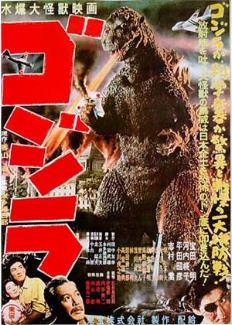
    Nearly everyone who’s seen a Godzilla movie knows that the Big G originated in Japan. However, the movie that actually introduced Godzilla has not been available in America until relatively recently.

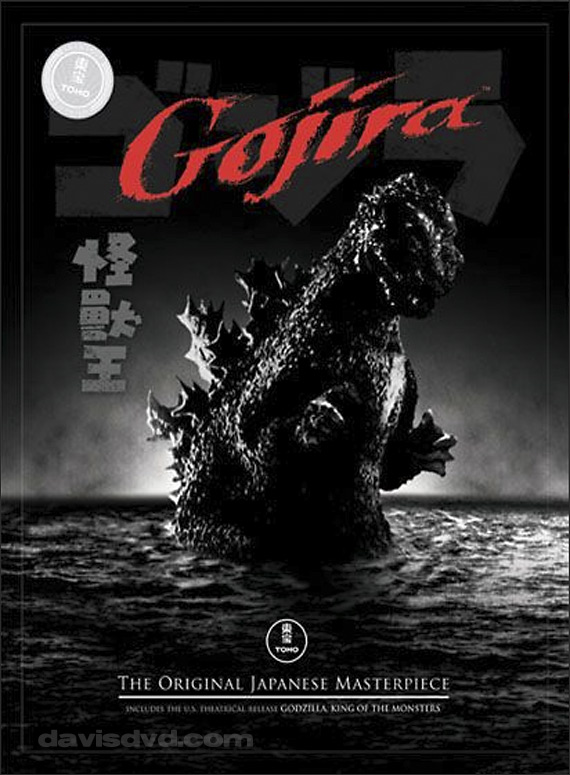
    I’m not talking about . Godzilla, King Of the Monsters. I’m talking about the original Japanese production, Gojira. “King Of Monsters” includes an hour’s worth of footage from the original, rearranged and re-edited to incorporate new scenes with Raymond Burr. However, a full-length version of Gojira had a short theatrical run in America in 2004 and it’s now part of a classy--and inexpensive--DVD boxed set with Godzilla, King Of the Monsters..

    Even if you’ve seen other movies in this series, I think Gojira is going to surprise you.

    According to the background material that comes with the DVDs, Gojira was born out of pure necessity. In early 1954, a major project for Toho studios in Japan fell through. In order to fill the hole in their production schedule, the studio heads decided to make a movie about a giant monster awakened by an atomic blast.

    By itself, this idea was nothing special; American movie-goers had already been introduced to The Beast From 20,000 Fathoms. What makes,Gojira different is the way this basic idea is handled. In it’s own way, the movie is a sincere attempt to grapple with a world with the atomic bomb, just as films like United 93 attempt to come to terms with a world where America can be attacked by terrorists.

    In the case of Gojira, though, the movie happens to include a man in a latex dinosaur suit.


    Much of the credit for .Gojira’s tone can be given to director and co-scripter Ishiro Honda. The son of a Buddhist priest, Honda was drafted into the Japanese Imperial Army in 1936, and fought as foot soldier for eight years in occupied China. After Japan’s surrender, he saw the ruins of Hiroshima on his way home.

    As Honda , who died in 1993, told one interviewer, “Most of the visual images I got were from my war experience. After the war, all of Japan, as well as Tokyo, was left in ashes. The atomic bomb had emerged and completely destroyed Hiroshima.

    “If Godzilla had been a dinosaur or some other animal,” he said., “he would have been killed by just one cannonball. But if he were equal to an atomic bomb, we wouldn’t know what to do. So I took the characteristics of an atomic bomb and applied them to Godzilla.”

    Honda came to Gojira,after directing documentaries for Toho, so the movie has a grainy, newsreel look that helps to establish the story’s realism. That can still be seen in “King Of Monsters,” though. There are some things that don’t make into the American version, or, if they do, it’s in a very altered form.

    The original includes a scene where the members of a government committee argue over telling the public that the appearance of Godzilla is connected to atomic testing ( They finally decide to do so.)

    During Godzilla’s rampage through Tokyo, there’s a touching scene where a mother tries to comfort her children by telling them that they’ll be with their father soon. In “King Of Monsters”, this scene is reduced to just a few seconds, with no dialogue.

    In the same movie, after the oxygen destroyer kills Godzilla (apparently), Raymond Burr intones, “ The whole world could wake up and live again.” In the original, though, Dr. Yemane warns, “If we continue testing H-Bombs, another Godzilla will one day appear.”

    (If you’re wondering why I’m using the name Godzilla, no matter which movie I’m referring to, it’s mostly a matter of convenience. However, in this DVD set, the subtitles in Gojira, do use the name Godzilla, despite the title of the movie. Honda’s quote also used Godzilla.)

    In general, Gojira has a darker, more somber tone than its American cousin, and it’s filled with images of ruined cities and orphaned children, inspired by reports from Hiroshima and Nagasaki. In comparison, Burr tells the story of Godzilla, King of the Monsters as a flashback, which eliminates some of the tension immediately, since we can be fairly sure that Burr’s character survived the monster’s attack.

    Still, I really don’t want to badmouth “King Of Monsters” here. It’s nobody’s classic, but it’s fun to watch. In addition, the scenes with Burr are integrated pretty well from a technical viewpoint, particularly when you consider that the filmmakers are doing it without the help of computers. It’s just a very different movie from Gojira.

    ***
    It looks like it’s time for me to start earning my merit badge in self-promotion. I’ve got essays in two books of BenBella’s Smart Pop series which are now in stores. One is Star Wars On Trial , which also has contributions by David Brin and Mathew Woodring Stover. The other is Getting Lost , edited by Orson Scott Card.

    The first book has a different format from most of the other Smart Pop entries. Pairs of writers debate different questions related to the Star Wars film. If you want to get a taste of what the book is like, check out the website at (surprise, surprise): www.starwarsontrial.com.

    I also have a short story in Lance Star-Sky Ranger, a pulp-style anthology now available from Wild Cat Books. You can take a close look at the book at: www.lulu.com/wildcatbooks.

    We return you now to your regularly scheduled blog.
     

    Thursday, September 21, 2006

    Star Trek Meets Monty Python

    Via Kolchak

    Friday, June 09, 2006

    Batwoman and the Teachable Moment

    from kolchak

    More than a few years ago, Mattel Toys tried to market a Barbie doll that came in a wheelchair. I don’t know whether it was a sincere attempt to promote diversity or a sincere attempt to separate more kids from their money. (I imagine it was a little bit of both.) In any case, the effort didn’t last long. Someone quickly discovered that the wheelchair wouldn’t go through the doorways of the various Barbie playhouses and the toy was recalled.

    I think I remember this incident because I always thought that Mattel missed what some educators like to call a Teachable Moment. IMHO, the official response should have been: “Yeah, we wanted to make it as much like the real world as we could.”


    All of which brings us --believe it or not--to the new Batwoman.


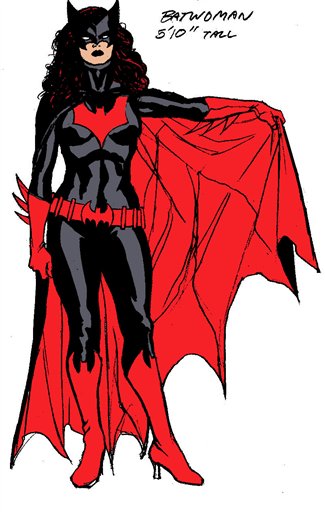
    In late May, DC Comics announced that it was going to reintroduce Batwoman, a character who first appeared in 1956. This version of the character, though, would be substantially different from the original; she would be a lesbian, a Gotham City socialite named Kate Kane. Her first appearance is scheduled for 52 #11, due out in July. (52 is a weekly comic that will feature a variety of characters over a year-long run.)

    This announcement has resulted in an unexpected amount of publicity from themainstream news media. Most of it has been positive, although some of it has just been clueless. CNN’s Jeanne Moos did a spot which started with the theme of the Batman TV series, which, in this case, is equivalent to putting on a sign that says I HAVE NO IDEA WHAT I’M TALKING ABOUT.

    Anyway, it’s ironic to see the name Batwoman associated with an attempt to make Batman more edgy and modern, because, when it was first used, the intention was probably the reverse. The original Batwoman--who was called Kathy Kane, incidentally -- was introduced along with Batgirl to make Batman and Robin look more like a standard family (And if you want to replace the phrase “standard family” with“straighter,” I’m not going to disagree with you.)

    Here’s how Jeff Rovin describes the first Batwoman’s weapons in his TheEncyclopedia of Super Heroes: “a powder puff with sneezing powder, lipstick which doubles as a smoke bomb, tear-gas disguised as perfume, bracelets which are actually handcuffs and a large super-strong ‘hairnet’ to snare fleeing adversaries...”

    Another point that hasn’t been made often enough is that Kate Kane isn’t the first gay costumed character. The earliest one I can find is Extrano, who was a member of a team called the New Guardians, a comic that DC published in the late 1980s. Since then, comic fans have seen Spectral, in the Strangers; Apollo and Midnighter, in the Authority, and Hulkling and Wiccan in the Young Avengers.

    Gay supporting characters have become more common too. According to DC’s press releases, Kate Kane had a relationship with Renee Montoya, a gay police officer who has been part of Batman’s supporting cast for a few years now.

    Ultimately, though, this all boils down to: So Batwoman’s a lesbian...and? At this point, it’s not possible to say whether she’s going to be an intriguing character ( much less a successful one.) We don’t know what her motivation is; who the people in her life are or whether she has a distinctive approach to fighting crime.

    Pictures of her costume have been released and the outfit is nothing special. It seems to borrow a lot from the futuristic Batman seen in the animated show Batman Beyond. (Although one post I’ve seen has criticized Kate for wearing the “Stripper Boots of the Patriarchy.”). So, in the long run, Batwoman’s sexuality is going to be only one facet of her character. I’m just hoping that, at some point, the Powers That Be at DC will say, “Yeah, we wanted to make it as much like the real world as we could.”

    That would be a Teachable Moment.

    Monday, February 27, 2006

    A Few Thoughts About Darren and Carl

    from Kolchak:


    A few months ago, handdrummer asked me to write something about the attempt to resurrect The Night Stalker television show on ABC. I started to think about how this watered-down, prettied-up version of Kolchak could be taken as the most bizarre monster the original had ever faced. Before I could write anything, though, the new series was put out of our misery.

    But it looks like I’m going to be writing about Kolchak after all. Darren McGavin, the actor who originated the role, died on Feb. 25, at age 83.

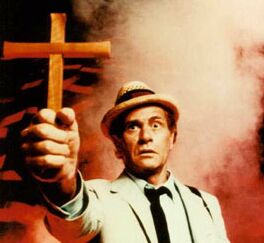
    McGavin is probably best known to modern audiences as Ralphie’s Old Man in the 1983 movie A Christmas Story. He made hundreds of television and movie appearances, however, and, for a lot of us, he will always be associated with Carl Kolchak, the down-but-never-out newspaper reporter who fought relentlessly to bring stories about supernatural menaces to the public.

    Kolchak was introduced in a 1972 made-for-TV movie called -- you guessed it--The Night Stalker. Based on a story by a journalist named Jeff Rice, the movie tells the story of how Kolchak discovers a vampire in modern-day Las Vegas. He defeats the vampire but learns he can’t defeat the politicians and business men who run Vegas.

    The movie garnered the highest ratings of any made-for-television film up to that point. Horror Veteran Richard Matheson, who adapted Rice’s story, and Producer Dan Curtis made substantial contributions to the first movie’s success, of course.


    But it’s hard to underestimate McGavin’s performance as Kolchak. Dressed in a well-worn seersucker suit-- the last suit he owned, according to McGavin-- Kolchak immediately became an iconic character-- hard-boiled, yet devoted to uncovering the truth. He was a spiritual descendent of Hildy Johnson, the lead character in The Front Page. (For years, I thought McGavin must’ve appeared in a production of The Front Page, in order to inhabit Kolchak so quickly and so thoroughly. But all the credit lists I’ve read say he didn’t. He did go on to play other journalists though , including E.K. Hornbeck, --who was based on H.L. Mencken-- in a 1988 production of Inherit the Wind.)

    The Night Stalker was followed by a second movie, The Night Strangler, in 1973. It didn’t make as big of a splash as the original, but McGavin’s style--and his relationship with Editor Tony Vincenzo (Simon Oakland)-- made the sequel popular. A third movie-- The Night Killers -- was scripted, but was never produced. Instead, ABC went for a television series in 1974.

    Many talented people were involved withthe show; along with McGavin and Oakland, there were writers David Chase (The Sopranos), Bob Gale and Robert Zemeckis (Back to the Future) and actors who would go on to star in other series. However, they never did come up with a reliable way to deal with budgetary problems and problems with what tone the series should have. It was canceled after 20 episodes (FWIW, last fall’s trainwreck, er, attempted revival, lasted nine episodes, although 12 were produced.)

    That should’ve been the end of Carl Kolchak. Only it wasn’t. The TV episodes enjoyed a second life in a late-night slot on CBS (this was well before David Letterman took over that position.) Now they’re running four or five a time, once every month or so, during the day on the Sci-Fi Channel (who will also be running the newer episodes, sometime this summer.) McGavin’s adventures have collected onto a DVD set, while new adventures, using his interpretation of the character are being published by Moonstone Books. Most of these stories are in comic book form, but Moonstone also released an anthology of text “Night Stalker” stories late last year.

    Kolchak has made himself known in other ways, too. Chris Carter, creator of The X Files , regularly said in interviews that he was heavily influenced by The Night Stalker. Carter and his creative staff formally acknowledged that influence when McGavin appeared on two episodes of The X Files as Arthur Dales, the first FBI agent to be formally assigned to the X Files section.

    The first of these episodes, 1998’s “Travelers,” is definitely worth looking for. Most of it is a flashback set in the 1950s, with a younger actor playing Dales, but McGavin appears in a framing sequence and narrates the flashback. This was a particularly elegant approach, because it suggested the format of the original TV show and it allowed McGavin to use one of his strongest acting tools, his distinctive raspy voice.

    Another post-Kolchak performance of McGavin’s that you should check out is Mastergate, a political satire by Larry Gelbart made in 1992, where he appears as Sen. Fulsom Bunting.

    Public awareness of Kolchak may have waxed and waned, but he was always part of my personal pantheon of heroes and heroines. In the late 1970s and early ‘80s, I was part of a committee--led by our esteemed handdrummer--who put on an annual science fiction convention in Central Pennsylvania. For the costume call at that first convention, I managed to cobble together a recognizable facsimile of Kolchak’s distinctive suit. The suit is long gone, but we still have a photo of me in costume, interviewing another convention goer, dressed as Dr. Frank N. Further, from The Rocky Horror Picture Show.

    And from time to time, at later editions of the convention, people I would be talking with would pause and says something like, “Oh, yeah, you were the one dressed like Kolchak.” And I know it wasn’t because it was such a professional-looking costume...


    I think I still have a copy of a fan fiction vignette I wrote where JackMagee, the reporter who pursued the Hulk through his television incarnation, went to a retired Kolchak for help.

    When Gordie “The Ghoul” Spangler (John Fiedler) appeared on the television show as a Chicago morgue attendant, I immediately started to refer to him as Uncle Gordie. I sold an article about The Night Stalker to a nationally circulated magazine called Xpose. And when handdrummer recruited me for the Blatt, he suggested Kolchak as my nom du screen.

    Why has Kolchak stayed with me over the years (hell, decades)? I’ve been thinking about that a lot over the last few days, since I learned that McGavin had been hospitalized and was considered “gravely ill.” The answers aren’t particularly original, but here they are:
    • Kolchak combined two of my strongest interests: journalism and fantastic literature (I’m including science fiction, horror and fantasy here, although Kolchak’s adventures were primarily horror.)
    • And he was a role model for aspiring journalists (though I’m not sure the phrase “role model” even existed in the early1970s.) While he usually scored a victory over the Monster of the Week, he almost never triumphed over the bureaucratic or political power structure of the modern world. He was never a success by the criteria most people would use to define the word. He was considered a pariah on many levels of society. But that never stoppedhim from getting the story. The Night Stalker was primarily about the supernatural, but it was definitely about journalism too.
    And I know I’m not the only writer who feels this way. Mark Dawidziak, who has written extensively about the character, tells this story in his book, The Night Stalker Companion:

    Crossing a newsroom several years ago...I saw one of the newspaper’s finest reporters waving his arms in a manner that suggest a condition somewhere between outrage and apoplexy....

    “This,” the indignant reporter shouted as he waved a late edition under the editor’s nose, “is a newspaper. We are a newspaper! We are supposed to print the news!”

    If the delivery had not been letter perfect, the lightbulb might never have reached the illumination stage. But I realized he was borrowing Carl Kolchak’s fiery tirade to editor Tony Vincenzo in The Night Stalker.

    I got it and couldn’t resist saying so.

    “You’re right,” he said, all smiles...”You’re the first one who got it. ...I always thought that Kolchak was the closest television ever came to capturing a true reporter.”


    When the original series first appeared, my friends and I used to talk about how there had to be some sort of reason why Kolchak encountered all these supernatural beings. Now, though, I find that a rationale that explained Kolchak’s adventures isn’t as important as it used to be. That’s just the way things were in his world. But it never stopped him. He just kept coming. Maybe that’s why I still think about him.

    Darren McGavin left us a large and impressive body of work, but my favorite will
    always be Carl Kolchak.

    Thursday, February 23, 2006

    Salarymen In Space

    from Kolchak:


    A long time ago, in a galaxy far, far-- no, wait; let me try that again.

    In 1978 (I told you it was a long time ago), a short-lived TV series called Quark ran on NBC. It was, of all things, a science fiction comedy, starring Richard Benjamin as the captain of a starship that collected garbage discarded by other planets. It poked gentle fun at things like Star Trek and 2001: A Space Odyssey and quickly established itself as being too hip for the room. It lasted only eight episodes.

    Now, more than 25 years later, there’s another spaceship out there collecting trash. This one, though, is part of the Japanese series Planetes. There are some laugh-out-loud funny scenes in the series, but it also has some very serious things to say about space travel and its cost--social and emotional, as well as financial. The result is a real rarity: a genuine, hard science fiction story, in visual form. In Japan, Planetes received the Seiun Award, which is roughly equivalent to the Hugo in this country.

    Created by Makoto Yukimura, Planetes is available here in America both as a
    manga and as an anime DVD. (For the record: Tony Oliver, writer of theEnglish script and English voice director for the DVD, pronounces Planetes“planet-tis.” I’m going to go with that until I hear otherwise.).

    Planetes follows the crew of the Toy Box, a ship that collects outmoded satellites and other, potentially dangerous man-made debris. In this world--roughly 70 years in the future--the human race has a strong presence in outer space. The asteroid belt is being explored, and the first generation born and raised on the moon is nearing adulthood.

    At the same time, extremist groups are trying to keep man out of space, sometimes through violence.

    As you might imagine, the work done by the Toy Box’s crew, while important, gets little respect. This is particularly grating to Hachimaki Hoshino. As Planetes begins, Hachi (Hachimaki--or Hachi--is a nickname, which refers to the headband that he constantly wears.) is trying to save enough money to buy his own ship.

    Before long, though, he decides to apply for the first expedition to Jupiter, which will be captained by his estranged father, in order to earn the money that he wants.

    Goro Hoshino is a veteran astronaut, but somewhat lacking as a human being, a womanizer who has all but abandoned his family. He’s not about to welcome his son with open arms.

    As Yukimura chronicles Hachi’s journey, he also creates backgrounds for theother members of the Toy Box’s crew. Yuri Malakoff is trying to deal with hiswife’s dying from--and his surviving--an accident caused by space debris. For a long time, the most important thing in Fee Carmichael’s life seems to be finding a legal--and safe--place to smoke on the moon. However, she eventually finds something else to fight for.

    The stories in Planetes range significantly in tone. In an early sequence, a well-known resident of the lunar colony walks out on the surface and waits for his life support run out, rather than returning to Earth. In another story, Tanabe--a later addition to the crew-- befriends a young man known as the Baron, who claims to be an extraterrestrial. (Nobody except Tanabe believes this, but nobody thinks this disqualifies the Baron from working in space.)

    On the visual side, all the characters in Planetes can be identified as coming from a manga. They look positively naturalistic, though, compared the highly-stylized characters in such recent series as Mobile Suit Gundam SEED and Heat Guy J. In addition, vehicles and astronomical scenes are rendered with meticulous attention to detail.

    Yukimura seems to have done his research in other areas as well. The story includes numerous references to the history of space travel and rocketry, going all the way back to ancient Japanese fireworks. Also, the fourth and fifth volumes of the American manga--which are labeled 4/1 and 4/2, for the record--have articles that explain the social trends and the science behind the world that he’s created.

    The Planetes DVDs makes a lot of changes in the series, both cosmetic and significant. Tanabe is the viewpoint character now. The crew of the Toy Box is based on a space station, rather than on the moon. Hachi and the others are now working for Technora Corporation (they were independent contractors before), which gives the anime’s creators a chance to have fun with Japanese corporate life.

    In the first of 26 episodes, Tanabe is greeted by a creature that looks like a pink version of Cousin Itt from The Addams Family. It looks like it could be an alien, but it’s only someone dressed as the corporate mascot.

    Several new characters are added to the cast, primarily as comic relief, including two managers and a clerical worker who seems to be a tribute to Janine Melnitz from Ghostbusters.

    The anime takes its own sweet time getting to the Jupiter expedition, though. Although Hachi’s father is seen in the credits, the first time the expedition is mentioned is Episode 14. In addition, turning Hachi and Tanabe into a romantic couple takes longer than it has to.

    On the other hand, some of the original sub-plots are very similar tothe spirit of the manga. In ‘The Lunar Flying Squirrels,” a group of residents of the lunar colony decide that the moon is a great place to restage scenes from their favorite ninja movies. In “Boundary Line,” the anime’s creative staff takes what could be a mind-numbingly abstract question-- how do Third World countries get access to outer space?-- and turns it into a genuine human drama.

    The opening credits show a montage of the history of space travel, reflecting Yukimura’s interest in that aspect of the field, and, ironically, creating a feel similar to the credits of Star Trek:Enterprise.

    The visual style of the anime of similar to that of the original, with fairly realistic character and vehicle designs. The space station appears to be a computer-generated image, but the rest of the series seems to be traditional animation.

    The DVDs do contain some unique extras. Along with mini-documentaries on real space debris, there are “audio dramas:” scenes performed by the English voice cast and illustrated by still drawings.

    I haven’t been able to determine how or why these dramas were created. The best theory I’ve heard is that the voice actors recorded the dialogue for these scenes, but they were cut before the episodes were animated. I have to admit, though, that I haven’t been able to find out for sure.

    The Planetes anime is divided among six DVDs. The final DVD in the run is scheduled for release in March.